Ancient Engineering · Abu Rawash, Egypt

Pyramid of Djedefre

Egypt's northernmost pyramid was once nearly the equal of Giza — so where did it go?

Mainstream: c. 2560 BC (4th Dynasty, reign of Djedefre)Alternative: Dynastic date accepted; destruction blamed on catastrophe, and granite cuts on lost machining30.03°, 31.07°

At a glance

Pyramid of Djedefre
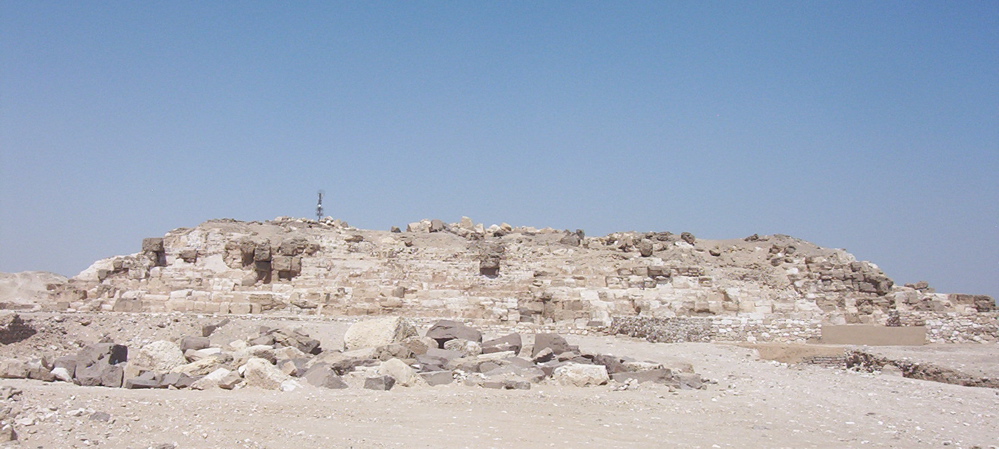
Photo: Wikimedia Commons · Public domain

Eight kilometres north-west of Giza, on a commanding hilltop at Abu Rawash, stand the ruins of the pyramid of Djedefre, son and successor of Khufu. Planned with a base of about 106 metres and a slope of roughly 52 degrees, it would have risen some 67 metres — and because its hill stands high above the Nile plain, its apex would have stood loftier above the valley than the Great Pyramid itself. Today barely 11 metres of core survive above a huge rock-cut descending trench, surrounded by fields of granite and limestone debris.

See it on the globe →
The mainstream view

What archaeology says

Egyptologists attribute the pyramid to Djedefre, the 4th Dynasty king who ruled between Khufu and Khafre in the mid-third millennium BC. For much of the twentieth century it was assumed the monument was abandoned unfinished when Djedefre died after a short reign — Vito Maragioglio and Celeste Rinaldi argued it never rose far above its base. The Franco-Swiss mission that worked at the site from 1995, directed by Michel Valloggia with Michel Baud, overturned much of that picture: their excavations, published in 2011, indicated the pyramid was substantially built, perhaps more than half finished and possibly completed, with an unusually generous use of red granite casing on its lower courses.

The ruinous state of the monument is explained not by ancient failure but by later stone-robbing. Quarrying began by the end of the New Kingdom at the latest and became industrial in scale during the Roman and early Christian eras, when the pyramid served as a convenient quarry for the region. The process was still running in the nineteenth century: Flinders Petrie recorded stone being carted off at a rate of three hundred camel-loads a day.

Far from being a marginal monument, Abu Rawash is read by mainstream scholars as evidence of dynastic politics — Djedefre's decision to build away from Giza, and his adoption of the title Son of Ra, mark an important religious shift towards the solar cult that would dominate the 5th Dynasty.

Key evidence cited
  • Franco-Swiss excavations (1995-2005, Valloggia and Baud) found the pyramid was substantially built, not barely begun
  • Quarry marks and workmen's graffiti tie the monument to Djedefre's reign
  • Roman and Coptic-era spoil heaps document centuries of systematic stone removal
  • Petrie witnessed 300 camel-loads of stone leaving the site daily in the 19th century
  • The 21 x 9 metre descending trench matches standard 4th Dynasty substructure design
  • A famous quartzite head of Djedefre was found in the boat pit beside the pyramid
The alternative view

What the skeptics propose

Alternative researchers are drawn to Abu Rawash for two reasons: the violence of its destruction and the character of its stonework. Writers in the catastrophist tradition find it hard to accept that patient quarrying alone reduced a near-Giza-scale pyramid to a stump, and suggest instead that some devastating event — natural or otherwise — tore the structure apart, pointing to the chaotic spread of shattered blocks around the hill.

The engineer Christopher Dunn, author of Lost Technologies of Ancient Egypt (2010), examined a granite block at Abu Rawash bearing a curved, striated cut and argued that its geometry implies a large mechanical saw rather than pounding stones and copper tools — part of his broader case that Old Kingdom granite work encodes a sophisticated lost machining capability. Sceptics reply that experimental archaeology with sand-and-copper sawing reproduces similar marks.

Robert Bauval and Adrian Gilbert also folded Abu Rawash into the Orion correlation theory proposed in The Orion Mystery (1994), suggesting the outlying pyramids at Abu Rawash and Zawyet el-Aryan completed a star map of Orion on the ground — a reading Egyptologists reject as selective, but which keeps the lonely hilltop firmly on the alternative-history itinerary.

Key evidence cited
  • Christopher Dunn's analysis of a granite block with a curved saw-like cut suggesting advanced machining
  • The sheer thoroughness of the destruction, argued by catastrophists to exceed plausible quarrying
  • Hilltop siting that made its apex stand higher than the Great Pyramid's, hinting at deliberate landscape design
  • Bauval and Gilbert's proposal that Abu Rawash marks a star of Orion in a ground plan
  • Extensive use of hard granite casing, unusual and technically demanding for the period

Genuinely open questions

  1. How complete was the pyramid at Djedefre's death — half built, or fully finished?
  2. Why did Djedefre abandon Giza for a remote hilltop his successors ignored?
  3. What proportion of the destruction belongs to each era of quarrying?
  4. What did the curved cut on the granite block — conceded by all sides to be real — actually make it?

Worth knowing

In the 1880s the pyramid was still being dismantled at a rate of three hundred camel-loads of stone a day.