What archaeology says
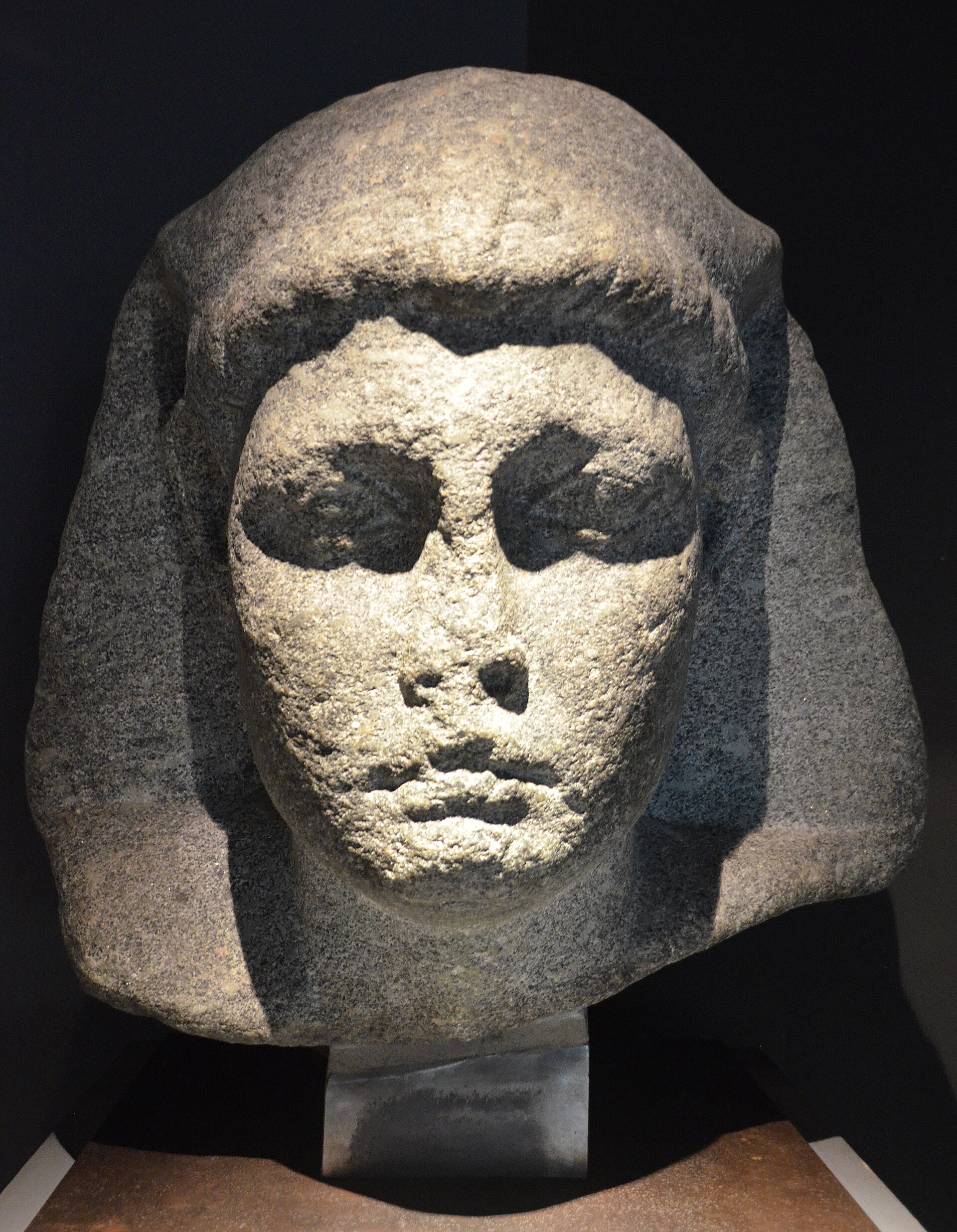
Goddio's systematic survey of the 400-hectare eastern harbour (1992–1996 and ongoing) recovered the true geography of the Portus Magnus, which turned out to differ substantially from older reconstructions based on Strabo. On the drowned island of Antirhodos, in about five metres of water, his divers mapped paved esplanades, red granite columns, and a modest marble-floored palace building, along with a statue of a shaven-headed priest of Isis, sphinxes — one bearing the face of Ptolemy XII, Cleopatra's father — and a colossal granite head thought to represent Caesarion, her son by Julius Caesar. The peninsula identified as the Timonium, Mark Antony's retreat after Actium, lies nearby. The submergence is attributed to a lethal combination of earthquake shaking, the great tsunami of AD 365 recorded by Ammianus Marcellinus, and steady subsidence of the harbour floor.
At the harbour mouth, Empereur's team catalogued more than 3,000 architectural blocks in the Pharos debris field from 1994, including 50-tonne granite doorjambs and lintels, colossal statues of Ptolemaic kings and queens, sphinxes and obelisk fragments — a mixture of lighthouse masonry and older monuments reused or displayed around it. A colossal statue of Ptolemy II raised from the sea now stands outside the Bibliotheca Alexandrina.
The work continues at scale. In mid-2025 the international PHAROS project, led by archaeologist Isabelle Hairy of the CNRS with Egypt's Ministry of Tourism and Antiquities and the Dassault Systèmes Foundation, lifted 22 monumental blocks — some around 80 tonnes — for scanning, joining over 100 blocks already recorded by photogrammetry in a project to build a complete digital twin of the lighthouse and test how it stood and how it fell. Egypt has repeatedly floated plans for an underwater museum over the royal quarter, which would be the first of its kind.
- Goddio's 1992–96 IEASM survey mapping the entire 400-hectare Portus Magnus and Antirhodos island
- Sphinx with the face of Ptolemy XII and a priest of Isis statue from the royal quarter seabed
- Empereur's catalogue of 3,000+ blocks in the Pharos debris field, including 50-tonne doorjambs
- Ammianus Marcellinus' account of the AD 365 tsunami, matching subsidence evidence of 5–6 metres
- The 2025 PHAROS project (Isabelle Hairy, CNRS) lifting 22 blocks for a full digital reconstruction