Belief & Society · Royston, Hertfordshire, England

Royston Cave

A bell-shaped chamber found by accident under a market street in 1742, ringed with crude medieval carvings — and backed by not a single word of documentation.

Mainstream: Carvings c. AD 1350–1390 (the cave itself is undated and could be older)Alternative: Before 1312 if the Knights Templar used it; other proposals run from a Neolithic flint mine to a seventeenth-century folly52.05°, -0.02°

At a glance

Royston Cave
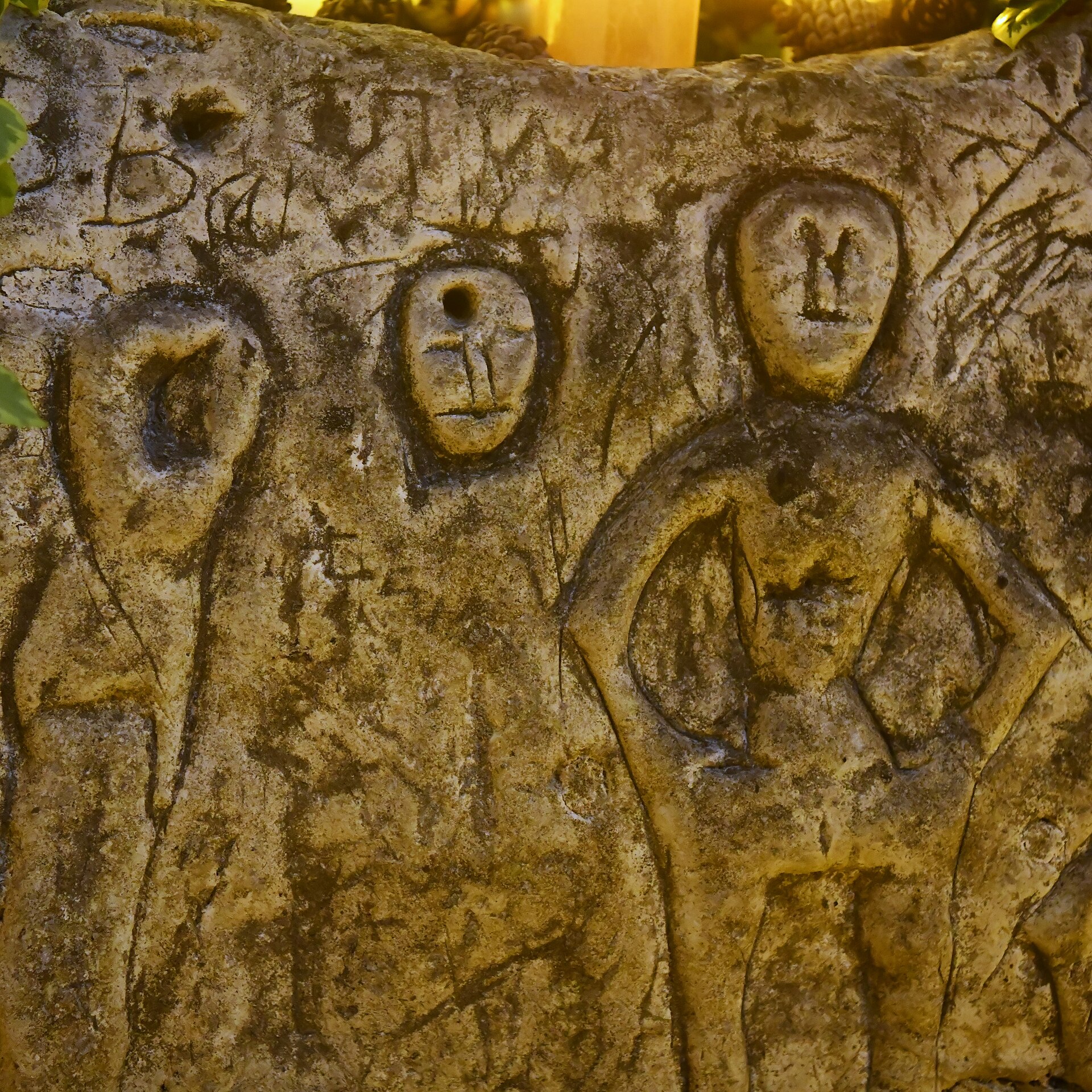
Photo: Michael Garlick · CC BY-SA 2.0

In August 1742, a workman digging footings for a new bench in Royston's Butter Market struck a buried millstone. Levering it aside, he found a vertical shaft with toeholds cut into the chalk, descending into darkness. A boy, then a slim volunteer, was lowered in; rumours of treasure spread, and cartloads of soil were hauled out until bedrock was reached. The spoil — containing bones, pottery fragments and a piece of skull — was examined for valuables, found to contain none, and discarded. With it went almost every clue to the cave's history. What the diggers had opened is a bell-shaped chamber roughly 8 metres high and 5 metres across, cut into the chalk directly beneath the crossroads of two great ancient routes: the Roman Ermine Street and the prehistoric Icknield Way. Around its lower walls runs a continuous frieze of shallow carvings — the Crucifixion, St Katherine with her wheel, a giant St Christopher, figures with swords, hearts, hands and a possible sheela-na-gig — crude in execution but dense with medieval Christian and folk imagery. No document of any period mentions the cave's construction or use. That total silence, in a well-recorded market town, is the heart of the puzzle, and it has made Royston Cave a magnet for theories ever since the antiquarian William Stukeley pronounced on it within months of its discovery.

See it on the globe →
The mainstream view

What archaeology says

Modern analysis focuses on the carvings, since the chamber itself contains nothing datable. Architectural historian Nikolaus Pevsner judged the figures 'of various dates between the C14 and C17, the work of unskilled men'. In 2012 the Royal Armouries examined the armoured figures and dated their equipment — full plate of a recognisable style — to about 1360–1390. Medieval graffiti specialists such as Matthew Champion place the imagery squarely within the mainstream of late medieval popular devotion: the same saints, crosses and apotropaic (protective) marks appear scratched in parish churches across East Anglia, and Champion notes that no verified Templar graffiti exists anywhere in England to compare it with.

On the cave's function, the sober candidates are a hermitage or anchorite's cell (Royston's priory records mention support for a local hermit), a chapel-like private oratory, or a cool store — the local Augustinian priory ran the town's markets, and a chalk chamber under the Butter Market would have kept produce fresh, with the millstone as a lockable lid. The Victorian antiquarian Alfred Kingston suggested a private chapel associated with Lady Roysia, the town's semi-legendary namesake. The shaft's toeholds and the octagonal band of sockets partway up the wall (perhaps for a timber floor or gallery) show the space was fitted out for regular use, not a one-off excavation.

The mainstream position, in short: a fourteenth-century devotional or storage chamber decorated by pious amateurs — remarkable, but explicable. What mainstream scholarship cannot supply is a document, a name or a firm purpose, and it concedes the point freely.

Key evidence cited
  • Royal Armouries analysis (2012) dating the carved figures' plate armour to c. 1360–1390
  • Close parallels between the carvings and ordinary late medieval church graffiti across East Anglia (Champion)
  • Pevsner's assessment of the figures as unskilled work of the fourteenth to seventeenth centuries
  • The Augustinian priory's control of Royston's markets, fitting a cool-store or oratory function
  • Toeholds, floor sockets and wall niches showing the chamber was fitted for routine practical use
The alternative view

What the skeptics propose

The famous theory belongs to local archaeologist and cave researcher Sylvia Beamon, who argued from the 1970s until her death that Royston Cave was used by the Knights Templar as a private oratory and cool store — a scaled echo of the round Church of the Holy Sepulchre. Her case is stronger than it is often given credit for: the Templars demonstrably operated in Royston, holding rights in the town's markets between 1199 and their suppression; the carvings' compressed, crowded style closely parallels graffiti attributed to imprisoned Templars in the tower at Chinon in France; and imagery such as St Katherine and the Holy Sepulchre theme fits documented Templar devotion. Beamon set out the argument in her 1992 book Royston Cave: Used by Saints or Sinners?, and the cave's official interpretation still presents it as the leading hypothesis.

The rebuttal is chronological: if the Royal Armouries' 1360–1390 dating of the armoured figures holds, the main carving campaign post-dates the order's 1312 dissolution by two generations. Defenders respond that the cave could have been cut and first used by Templars, with carvings accumulating for decades afterwards — the dating kills a Templar hand on the datable figures, not Templar origins for the chamber.

Beyond the Templars, the field is crowded: an early Freemasons' lodge; a Neolithic flint mine later reused (the region's chalk is riddled with prehistoric workings, though the cave's profile matches none); a cult site for James I, whose hunting lodge stood nearby and whose court dabbled in the occult; and folk-magic readings that see the carvings as layered protective marks around a crossroads — a place traditionally charged with supernatural risk. Each theory explains some features and stumbles on others; none can produce the missing document.

Key evidence cited
  • Documented Templar presence and market rights in Royston from 1199 until the order's suppression
  • Beamon's noted similarities between Royston's carvings and Templar prisoner graffiti at Chinon
  • The bell/beehive form read as echoing the round churches and the Holy Sepulchre tradition
  • The cave's position under the Ermine Street–Icknield Way crossroads, suggesting deliberate symbolic siting
  • The complete documentary silence, argued to imply secret or suppressed use rather than mundane storage

Genuinely open questions

  1. When was the chamber itself first cut — is it older than its fourteenth-century carvings?
  2. Why does no medieval or early modern document mention a decorated chamber under a busy market town?
  3. What did the discarded 1742 fill contain — and what dating evidence was lost with it?

Worth knowing

The first person into Royston Cave in 1742 was reportedly a small boy lowered down the shaft on a rope to report whether treasure lay below — the eighteenth-century equivalent of a borescope inspection.