What archaeology says
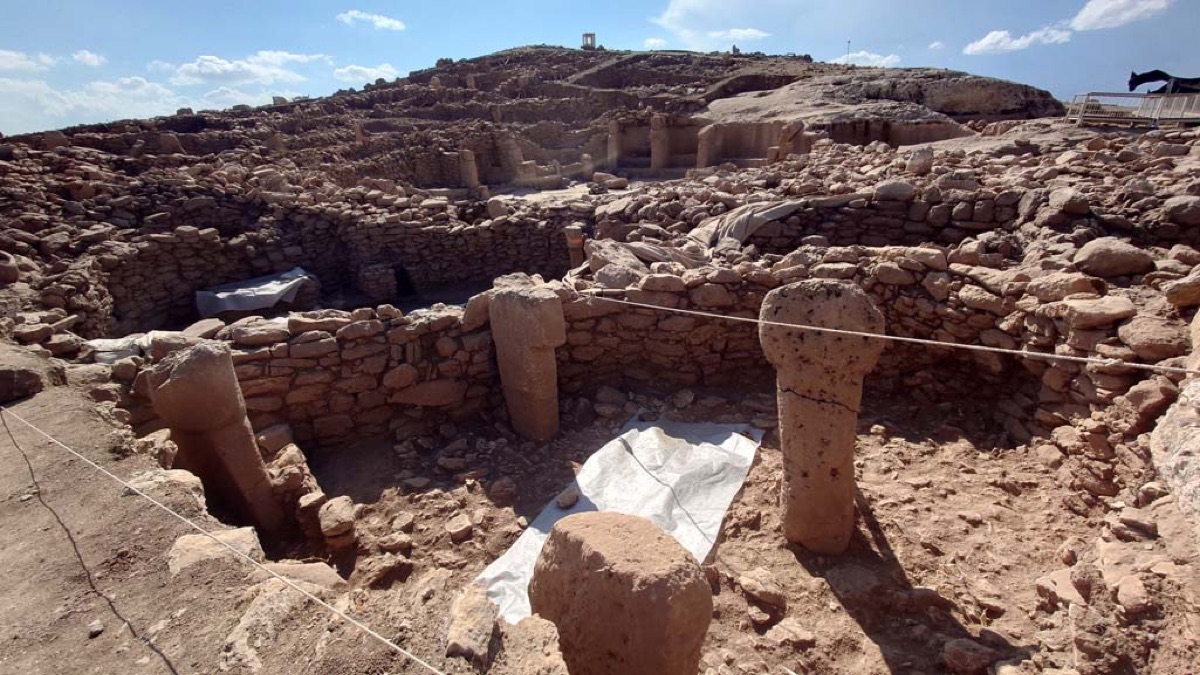
Archaeologists date Karahan Tepe's occupation to the Pre-Pottery Neolithic, roughly contemporary with Göbekli Tepe, on the basis of radiocarbon dates, lithic typology and architectural parallels. Crucially, Karahan Tepe settles a debate that raged over Göbekli Tepe: it is unambiguously a settlement. Domestic structures with hearths, floors and storage, harvested wild plant remains, and everyday tools sit right beside the monumental buildings. The 2025 discovery of a honeycomb of more than 30 semi-subterranean dwellings cut into bedrock reinforced the picture of a substantial resident community of complex hunter-gatherers.
The site's art is interpreted as an intensification of the same symbolic world seen at Göbekli Tepe, with a marked emphasis on the human form — the T-pillars themselves are increasingly read as stylised people, an interpretation strengthened by the human-faced pillar found in October 2025. Necmi Karul's team also reported a staged 'scene' of a stone vessel containing fox, vulture and boar figurines arranged on a plate, described as perhaps the earliest three-dimensional narrative composition known.
For the mainstream, Taş Tepeler as a whole shows a regional network of settled foragers experimenting with monumentality, social hierarchy and shared symbolism over more than a millennium — evidence of a long, local development rather than a sudden import from elsewhere.
- Radiocarbon dates and lithics place occupation firmly in the Pre-Pottery Neolithic, c. 9400–8000 BC
- Clear domestic architecture — hearths, storage, 30+ bedrock dwellings — proves a settled resident community
- More than 250 T-pillars carved from local bedrock, with quarry traces on site
- The 2023 seated statue and 2025 human-faced pillar fit an evolving regional artistic tradition
- A dozen related Taş Tepeler sites show gradual, local cultural development