What archaeology says
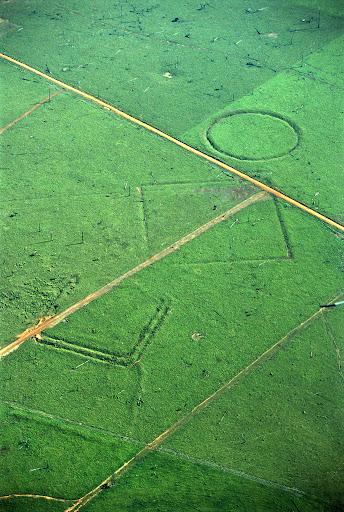
Systematic study of the geoglyphs was led above all by the Brazilian archaeologist Denise Schaan (who died in 2018) together with the Finnish archaeologist Martti Pärssinen and colleagues such as Sanna Saunaluoma, who mapped, excavated and dated dozens of sites. Radiocarbon dates from ditch fills and associated deposits cluster mainly between about 2,000 and 700 years ago, with pottery, grinding stones and other finds pointing to repeated use. A minority of samples run considerably older, and a 2020 study in Antiquity argued for land-use at these locations stretching back millennia. The prevailing interpretation is that the enclosures were not fortresses or villages but ceremonial and gathering places — the ditches too shallow and the interiors too clean of domestic refuse for defence or dense habitation — used intermittently by dispersed populations for ritual and communal events.
The most consequential mainstream work came from environmental archaeology. Jennifer Watling, with Schaan, Pärssinen and others, published a landmark 2017 study in the Proceedings of the National Academy of Sciences reconstructing 6,000 years of vegetation at two geoglyph sites, Jaco Sa and Fazenda Colorada, using phytoliths, charcoal and stable carbon isotopes. The result was striking: the region had been dominated by bamboo forest for millennia, and the builders had not clear-felled it. Instead they made only small, temporary openings to construct the earthworks, while enriching the surrounding forest with useful species such as palms — a form of long-term agroforestry rather than wholesale deforestation.
This reframed the whole debate about pre-Columbian Amazonia. Together with terra preta (Amazonian dark earths), raised fields and the later LiDAR discoveries of urban-scale settlements elsewhere in the basin, the geoglyphs became key evidence that large parts of the 'wild' Amazon are in fact an anthropogenic landscape, shaped and managed by sizeable societies for thousands of years before European contact.
- Over 450 mapped geometric ditched enclosures across ~13,000 km2 of Acre, documented by Schaan, Pärssinen and colleagues
- Radiocarbon dates on ditch deposits clustering c. 2,000–700 BP, with pottery and grinding stones showing repeated use
- Watling et al. (2017, PNAS) phytolith, charcoal and isotope record showing 6,000 years of managed bamboo forest, not clear-felling
- Clean, refuse-poor interiors and shallow ditches indicating ceremonial gathering places rather than forts or dense villages
- Convergence with terra preta, raised fields and LiDAR-detected settlements elsewhere confirming a widely peopled ancient Amazon