Ancient Engineering · Cusco, Peru

Sacsayhuamán

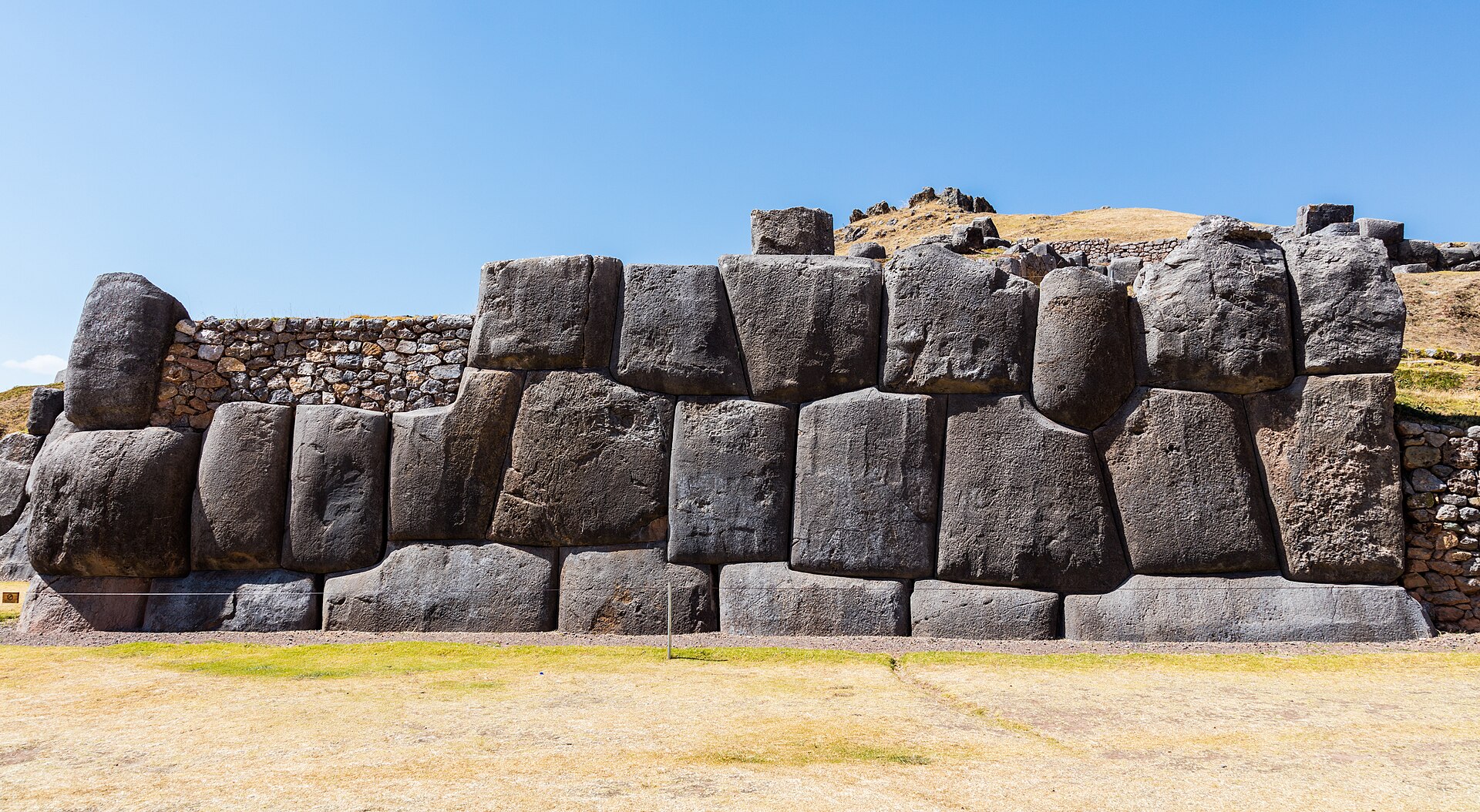
Three tiers of zigzag cyclopean walls above Cusco — the world capital of the polygonal masonry debate.

Mainstream: c. AD 1440–1530s (begun under Pachacuti, 15th century)Alternative: Megalithic base courses attributed to a far older culture — Gamarra's 'Hanan Pacha' phase, potentially thousands of years pre-Inca-13.51°, -71.98°

At a glance

Sacsayhuamán
Photo: Diego Delso, delso.photo · CC BY-SA 4.0

Sacsayhuamán crowns a steep hill overlooking Cusco, the former Inca capital, at about 3,700 metres altitude. Its most famous feature is a trio of immense zigzag terrace walls, some 400 metres long, built from limestone blocks fitted together without mortar in intricate polygonal patterns — the largest stones estimated at 125 tonnes or more, standing up to 8.5 metres tall. Spanish chroniclers who saw the complex intact described towers, storehouses and a labyrinth of buildings above the walls, most of which were later dismantled for building stone in colonial Cusco. The precision of the joints, into which famously not even a knife blade will fit, has made Sacsayhuamán the centrepiece of arguments about who could have built in this way, and when.

See it on the globe →
The mainstream view

What archaeology says

Archaeologists and historians attribute Sacsayhuamán to the Inca state at its height. Spanish chroniclers, including Cieza de León and Garcilaso de la Vega (himself half-Inca and raised in Cusco), recorded Inca oral tradition that the complex was begun under the ninth ruler Pachacuti in the mid-1400s and continued under Tupac Inca Yupanqui and Huayna Capac, with tens of thousands of workers supplied through the mita rotating-labour system. Radiocarbon dates and associated imperial Inca pottery from excavations at the site are consistent with this 15th–16th century construction window, and no stratified pre-Inca occupation layer has been demonstrated beneath the great walls.

The masonry itself has been studied intensively. Architect Jean-Pierre Protzen's experimental work in the 1980s showed that Inca-style polygonal joints can be produced by iterative pounding, fitting and abrasion with harder hammerstones, and abandoned blocks at Inca quarries carry tool marks matching his experiments. The zigzag walls are local limestone from outcrops close to the hill, and unfinished blocks, drag scars and construction ramps document the workflow. Engineering analyses have found that the interlocking, inward-leaning courses are superbly adapted to earthquakes — the walls have shrugged off tremors that flattened colonial Cusco — which explains the design as seismic pragmatism rather than mystery.

Historians add a sobering postscript: the Spanish used Sacsayhuamán as a quarry for churches and mansions, stripping away the smaller upper masonry and the three great towers whose foundations were only re-excavated in the 20th century. What survives today is essentially what was too big to steal — which, mainstream researchers note, is partly why the site looks so exclusively 'megalithic' now.

Key evidence cited
  • Spanish chronicles (Cieza de León, Garcilaso) recording Inca construction under Pachacuti and successors
  • Radiocarbon dates and imperial Inca ceramics from site excavations consistent with the 15th century
  • Protzen's experiments replicating polygonal fitting with hammerstones, matching quarry tool marks
  • Local limestone sources and abandoned blocks, ramps and drag scars documenting the workflow
  • No demonstrated pre-Inca occupation stratum beneath the megalithic walls
The alternative view

What the skeptics propose

Sacsayhuamán is the flagship site for the 'two (or three) styles of masonry' argument. Cusco researcher Jesus Gamarra, continuing the work of his father Alfredo Gamarra, divides Andean stonework into three eras: 'Hanan Pacha' (moulded or softened-looking stone cut directly into bedrock), 'Uran Pacha' (the giant polygonal walls) and 'Ukun Pacha' (the smaller, rougher masonry he accepts as genuinely Inca). In this scheme the cyclopean zigzag walls long predate the Inca, who merely inherited and repaired them. Gamarra and Dutch researcher Jan Peter de Jong also point to glassy, reflective surfaces on some stones as evidence of 'vitrification' — stone softened or heat-treated by an unknown technology.

Graham Hancock has presented Sacsayhuamán in this light in his books and the Ancient Apocalypse series, arguing that the contrast between the perfect megalithic courses and cruder later work suggests a lost civilisation's handiwork later attributed to the Inca, while Erich von Däniken earlier claimed the blocks were beyond any pre-industrial capability. Proponents ask fair questions: why do Spanish-era drawings and accounts marvel at the walls without describing their construction, why are the largest and finest stones at the bottom, and why does no surviving Inca account explain exactly how 100-tonne blocks were manoeuvred into interlocking positions on a hilltop?

Mainstream researchers respond point by point: the 'finest work at the bottom' pattern reflects structural logic and the Spanish removal of upper courses; the glassy surfaces are natural calcite polish and karst weathering of limestone, not vitrification; and chroniclers did record the Inca building the complex, including the death of hundreds of workers hauling one great stone. But the debate persists because no construction documents exist — the Inca had no writing — leaving the walls to speak for themselves.

Key evidence cited
  • Gamarra's three-styles classification placing the cyclopean walls in an older 'Uran Pacha' era
  • Claimed vitrified, mirror-like surfaces on some stones (de Jong and Gamarra)
  • The sharp quality gap between megalithic base courses and smaller upper masonry
  • Absence of any Inca written record or surviving eyewitness description of the method
  • The sheer scale — moving and fitting 100+ tonne blocks on a hilltop with no draft animals or iron

Genuinely open questions

  1. How exactly were the largest blocks — some over 100 tonnes — transported uphill and test-fitted repeatedly?
  2. What did the complete complex look like, given the Spanish dismantled the towers and upper structures?
  3. Was Sacsayhuamán primarily a fortress, a temple complex, or a ceremonial 'head' of puma-shaped Cusco?

Worth knowing

In Inca urban design Cusco was laid out in the shape of a puma — and Sacsayhuamán, with its zigzag walls, formed the puma's head and teeth. Every June the site still hosts Inti Raymi, the re-created Inca festival of the sun.