Belief & Society · Cerro Unita, Tarapacá Region, Atacama Desert, Chile

The Atacama Giant, Cerro Unita

The largest human figure ever drawn on the Earth's surface — an Andean deity, an astronomical calendar, and a favourite of ancient-astronaut lore.

Mainstream: c. AD 1000–1400 (late pre-Hispanic, Tarapacá / regional-developments era)Alternative: Date not seriously disputed — the debate is over what the figure represents, not its age-19.95°, -69.63°

At a glance

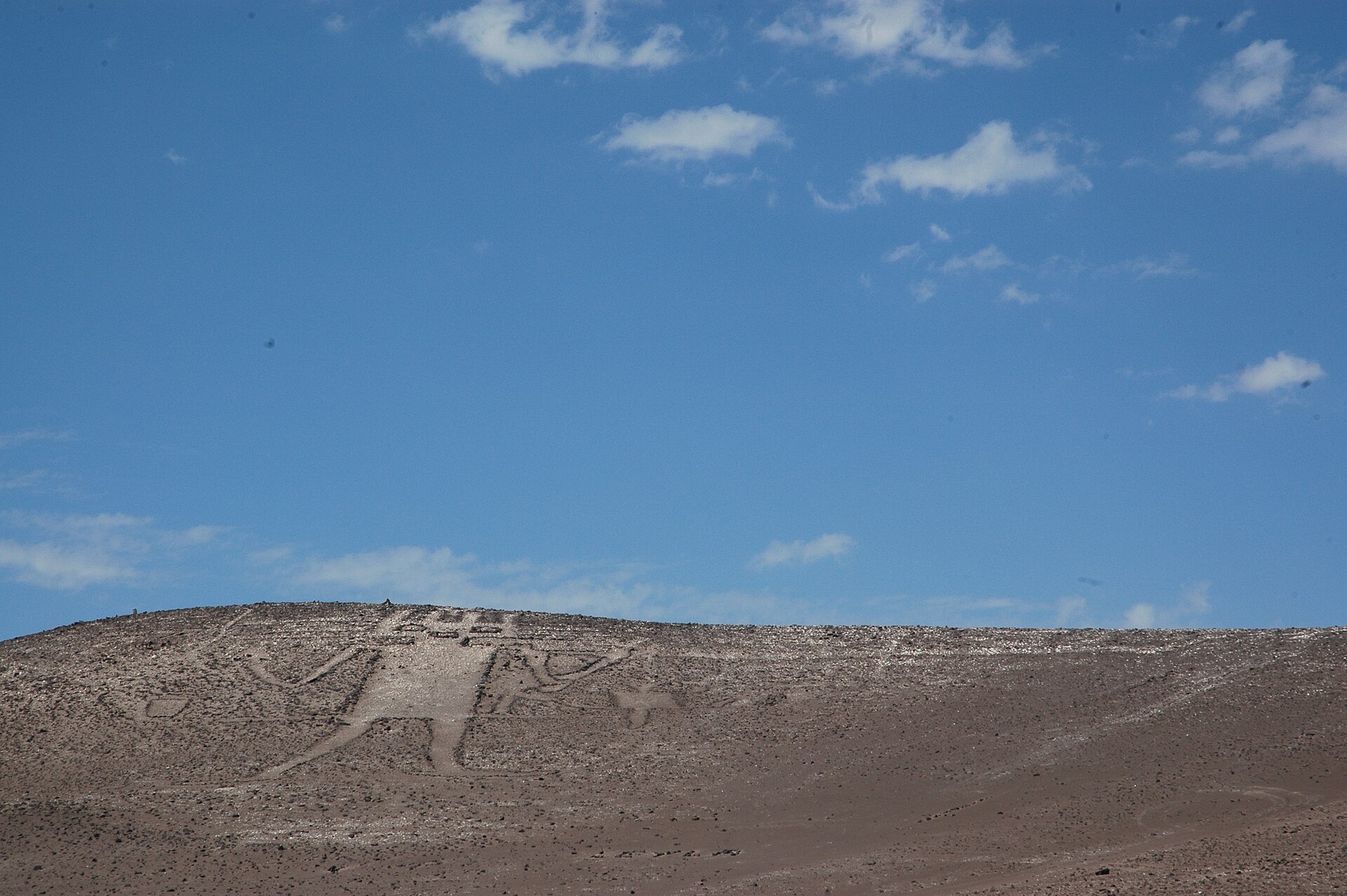
The Atacama Giant, Cerro Unita
Photo: Emilio Erazo-Fischer · CC BY-SA 2.0

On the northern flank of Cerro Unita, an isolated hill rising from the flat pampa of Chile's Atacama Desert about 15 kilometres from the town of Huara, stretches the Atacama Giant — at roughly 119 metres the largest prehistoric anthropomorphic geoglyph in the world. The rigid, rectangular figure has a squared head crowned with radiating rays or plumes, angular limbs, and a body divided by internal lines, all built up from arranged dark stones and cleared ground in the technique typical of Atacama geoglyphs. It is one of nearly 5,000 geoglyphs recorded across northern Chile, but its sheer scale makes it unique. The Giant belongs to a desert that functioned less as empty wilderness than as a network of routes. For centuries, llama caravans crossed the Atacama linking the Andean highlands to the Pacific coast, and the hillsides along their paths carry thousands of figures — humans, llamas, birds, geometric symbols — that appear to have marked trails, watering points and territories. Cerro Unita, a lone landmark on an otherwise featureless plain, would have been a natural waypoint, and its Giant the most commanding sign of all.

See it on the globe →
The mainstream view

What archaeology says

Chilean archaeologists date the Atacama Giant to the late pre-Hispanic period, roughly AD 1000–1400, placing it among the geoglyphs made during the Andean 'regional developments' era and associated broadly with the peoples of the Tarapacá region. Dating geoglyphs directly is notoriously difficult — there is no organic material in a pile of arranged stones to radiocarbon — so ages are inferred from associated pottery, stylistic sequences, and the caravan cultures known to have used these routes. The scholar most associated with the northern Chilean geoglyphs, Luis Briones, argued from decades of survey that the figures form a visual vocabulary tied to llama-caravan traffic: markers of routes, destinations and the groups who travelled them, with the travellers themselves gaining social prominence from about AD 800.

Within that framework the Giant is usually read as a powerful anthropomorphic figure — commonly linked to an Andean deity such as Tunupa, a creator and weather god of the altiplano — set as a territorial and ceremonial marker beside a major crossing. A widely repeated interpretation holds that the rays projecting from the head functioned as a rough astronomical or calendrical device: the alignment of the moon (and of the head's points) at different times of year could signal seasons and crop cycles for people who depended on knowing when rains and planting would come. This reading is plausible and often cited, though archaeologists treat it as an informed hypothesis rather than a proven function, since we have no inscription explaining the figure.

What is not in serious doubt is that the Giant is an indigenous Andean creation, made with locally attested techniques, within a dense regional tradition of desert geoglyphs whose broad purpose — marking a landscape organised around caravan mobility and ritual — is reasonably well understood.

Key evidence cited
  • Placement on Cerro Unita, a lone landmark beside major llama-caravan routes across the Atacama
  • Membership in a documented tradition of ~5,000 northern Chilean geoglyphs studied by Luis Briones and others
  • Construction using locally attested geoglyph techniques of arranged dark stones and cleared ground
  • Iconography (radiate head, deity association with Tunupa) rooted in Andean highland art and belief
  • Late pre-Hispanic dating (c. AD 1000–1400) inferred from associated pottery and regional stylistic sequences
The alternative view

What the skeptics propose

Because it is a colossal, stiff, radiate-headed humanoid staring up from the desert, the Atacama Giant became a natural exhibit for the ancient-astronaut genre popularised by Erich von Daniken in Chariots of the Gods. In this reading the crown of rays is a helmet or antenna, the boxy body a suit, and the figure a depiction of a visiting extraterrestrial or a signal meant to be seen from the sky — of a piece with the parallel claims made about the nearby Nazca Lines further north. The Giant's frequent appearance in television documentaries and online galleries of 'alien' imagery keeps this interpretation in wide circulation.

Steelmanning the underlying instinct: it is genuinely striking that a pre-industrial desert people invested the labour to lay out a 119-metre figure that can only be appreciated as a whole from a great distance or the air, and the rayed head does resemble later imagery of radiant or crowned beings. Those observations are the honest starting point that the ancient-astronaut writers exaggerate.

The rebuttals are decisive. Critics of von Daniken — from Carl Sagan and Kenneth Feder onward — long ago showed that his method begins with the alien assumption and bends every artefact to fit it, ignoring the abundant local context. The Giant's rays are a standard Andean convention for radiance, power and divinity, seen across highland art; the figure sits inside a documented regional tradition of thousands of geoglyphs made by known cultures for terrestrial purposes; and the technique, materials and style are entirely indigenous. Nor is size a mystery: laying out a large figure on open ground needs only cords, sightlines and organised labour, not aerial viewing. The extraterrestrial reading survives on the desert's strangeness, not on evidence.

Key evidence cited
  • The rayed 'helmeted' head and rigid boxy body invoked by von Daniken as a spacesuited visitor
  • The enormous 119 m scale, best appreciated from a distance or above, taken as evidence of aerial intent
  • Popular framing of the figure as a signal or portrait aimed at the sky, echoing Nazca-style claims
  • Superficial resemblance of the crown to later radiant or crowned 'celestial' beings
  • Persistent media and online circulation of the Giant among galleries of supposed 'alien' imagery

Genuinely open questions

  1. Can any independent technique tighten the figure's age beyond the broad AD 1000–1400 window inferred from context?
  2. Was the astronomical / lunar-calendar reading of the head's rays an actual function, or a modern hypothesis projected onto the design?
  3. Precisely which regional culture and community organised the labour to build the single largest geoglyph in the tradition?

Worth knowing

At about 119 metres the Atacama Giant is taller than the Statue of Liberty stacked on itself — the largest depiction of a human figure ever laid out on the surface of the Earth.