Ancient Engineering · Güímar, Tenerife, Canary Islands, Spain

Pyramids of Güímar

Six lava-stone step pyramids on a volcanic island — Thor Heyerdahl's last great mystery, or the world's most elegant farm clearance?

Mainstream: 19th century AD (agricultural stone-clearing terraces)Alternative: Pre-Hispanic Guanche era (as argued by Thor Heyerdahl, before the Spanish conquest of 1496)28.32°, -16.41°

At a glance

Pyramids of Güímar
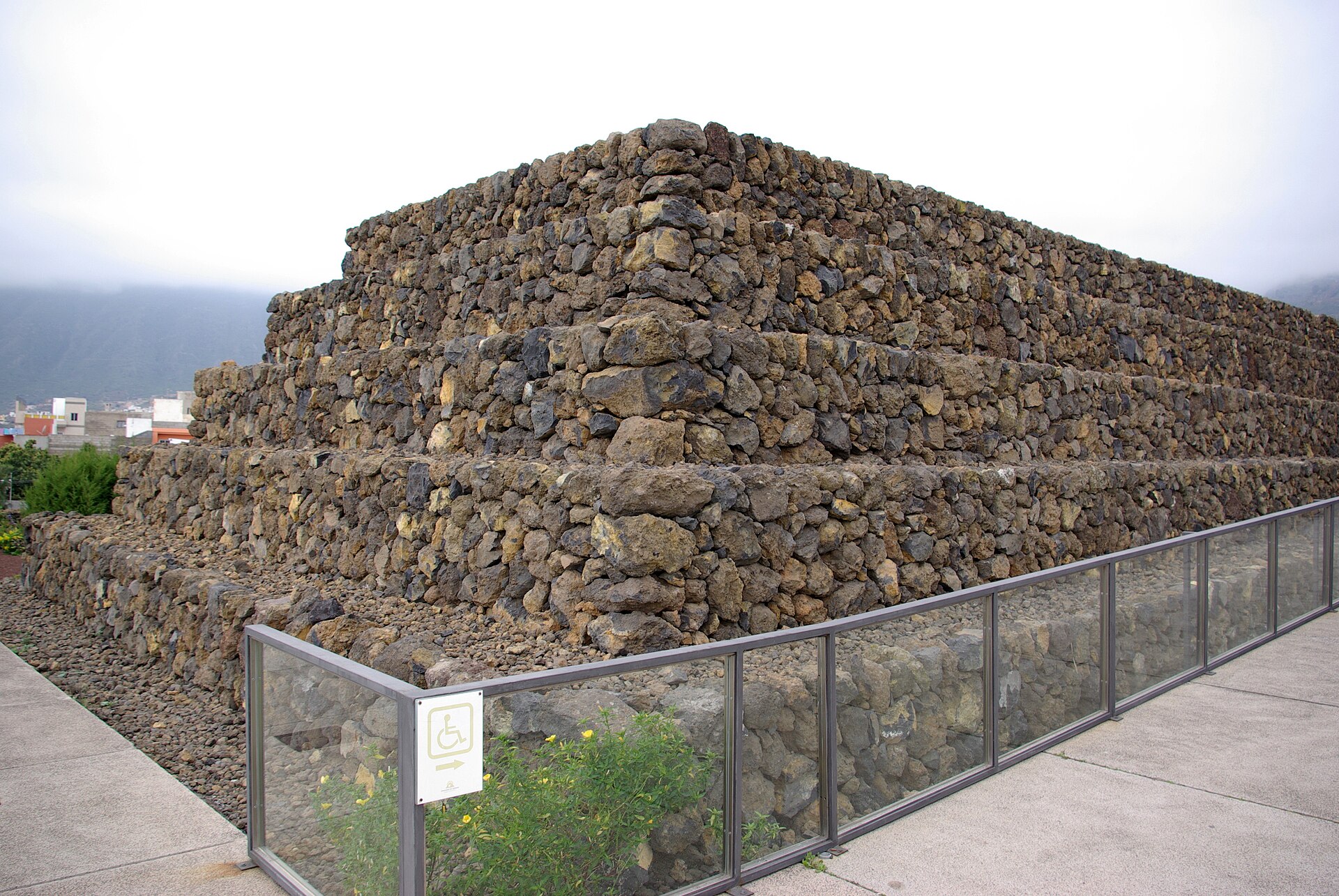
Photo: Berthold Werner · Public domain

In the town of Güímar on Tenerife's east coast stand six rectangular, flat-topped step pyramids of black volcanic stone, carefully built without mortar, the largest rising about 12 metres. Once there were nine or more such structures around the island. Long ignored as farmers' rubble piles, they shot to fame in 1990 when Thor Heyerdahl — the celebrated voyager of the Kon-Tiki and Ra expeditions — declared them genuine pyramids, moved to Tenerife to study them, and with shipping magnate Fred Olsen turned the site into an ethnographic park that still presents both readings side by side. The question they pose is simple and sharp: monument or majano?

See it on the globe →
The mainstream view

What archaeology says

Archaeologists and historians of the Canary Islands hold that the Güímar structures are terraced stone mounds of the 19th century, built when the land was cleared for cultivation. Rural Canarians habitually piled field stones into neat walled heaps called majanos, and on sloping volcanic terrain these took terraced, sometimes strikingly regular forms; comparable structures existed across Tenerife and the other islands, many demolished for building material in the 20th century. Between 1991 and 1998 archaeologists from the University of La Laguna excavated at the site with Heyerdahl's agreement. The stratigraphy was decisive: beneath the lowest courses of the pyramids lay a thin layer containing pottery sherds and artefacts of the 19th century — including an official seal dated 1848 — meaning the structures on top cannot be older. A natural lava cave beneath the edge of one pyramid did yield Guanche artefacts from roughly AD 600–1000, but as the cave predates the pyramid above it, it dates only the cave's use, not the construction.

Intriguingly, the mainstream account has absorbed a genuine astronomical discovery. In 1991 Juan Antonio Belmonte, Antonio Aparicio and César Esteban of the Instituto de Astrofísica de Canarias showed that the long sides of several structures mark the summer and winter solstices, and from the platform of the largest pyramid the summer-solstice sun can be seen to set twice behind the peaks above. Aparicio and Esteban later proposed that the 19th-century builders oriented the terraces deliberately, possibly influenced by Masonic symbolism current among the island's landowners — the property's owner in the mid-1800s is documented as a Freemason. On this view the pyramids are both recent and meaningful: solstice-aligned farm architecture.

Key evidence cited
  • 19th-century pottery in the layer directly beneath the pyramids' lowest courses
  • An official seal dated 1848 sealed under the structures during excavation
  • Documented majano stone-clearing mounds throughout the Canary Islands
  • University of La Laguna excavations (1991–1998) finding no pre-Hispanic material in the fabric
  • Land records showing the site under cultivation during the 19th century
The alternative view

What the skeptics propose

Heyerdahl rejected the farm-clearance explanation to his death in 2002. He argued the structures are too carefully built to be casual stone dumps: the corners are shaped blocks of lava, the sides face the solstices, the summit platforms are levelled and gravelled, and stairways ascend the western faces towards the rising sun — features he considered hallmarks of ceremonial architecture. For Heyerdahl the Canaries were the natural way-station on ancient transatlantic routes, and Güímar fitted his life's thesis: that sun-worshipping, pyramid-building, reed-boat-sailing peoples linked the Old and New Worlds long before Columbus, with Tenerife's indigenous Guanches — whose origins and mummification practices he found suggestive — as heirs to that tradition. His Ra expeditions had already shown papyrus vessels could cross the Atlantic; the pyramids, he argued, marked the stepping stone.

Supporters add that early chronicles and travellers' accounts mention stepped structures on the islands, that the Guanches used the cave beneath one pyramid, and that stone-by-stone construction with shaped corner blocks goes well beyond agricultural necessity. The Güímar ethnographic park, opened with Fred Olsen's backing in 1998, continues to present the case for a possible pre-Hispanic origin alongside the sceptical view.

Mainstream researchers reply that every documented element points the other way: the 1848 seal and 19th-century pottery beneath the structures, land registries showing the terrain cultivated in the 1800s, identical majanos across the archipelago, and the absence of any Guanche artefact within the pyramid fabric itself. The solstice alignments, they note, are real but explicable by the builders' documented era — and even Heyerdahl conceded he could not say who built them, only that he doubted they were mere stone heaps.

Key evidence cited
  • Carefully shaped lava corner-stones, levelled platforms and western stairways
  • Solstice alignments of the long sides demonstrated by Belmonte, Aparicio and Esteban
  • The double sunset over the peaks visible from the main platform at summer solstice
  • Guanche-era artefacts (c. AD 600–1000) in the cave beneath one pyramid's edge
  • Heyerdahl's Ra voyages proving ancient-style vessels could link Africa and the Americas

Genuinely open questions

  1. Who precisely built the Güímar structures, and were the solstice alignments intentional?
  2. Did Masonic or other symbolic motives guide 19th-century builders, as Aparicio and Esteban propose?
  3. How many similar structures existed across the Canaries before modern demolition, and were any older?

Worth knowing

Stand on the largest pyramid's platform on the summer solstice and you can watch the sun set twice — it dips behind one peak, re-emerges from its slope, and sets again behind the next.