What archaeology says
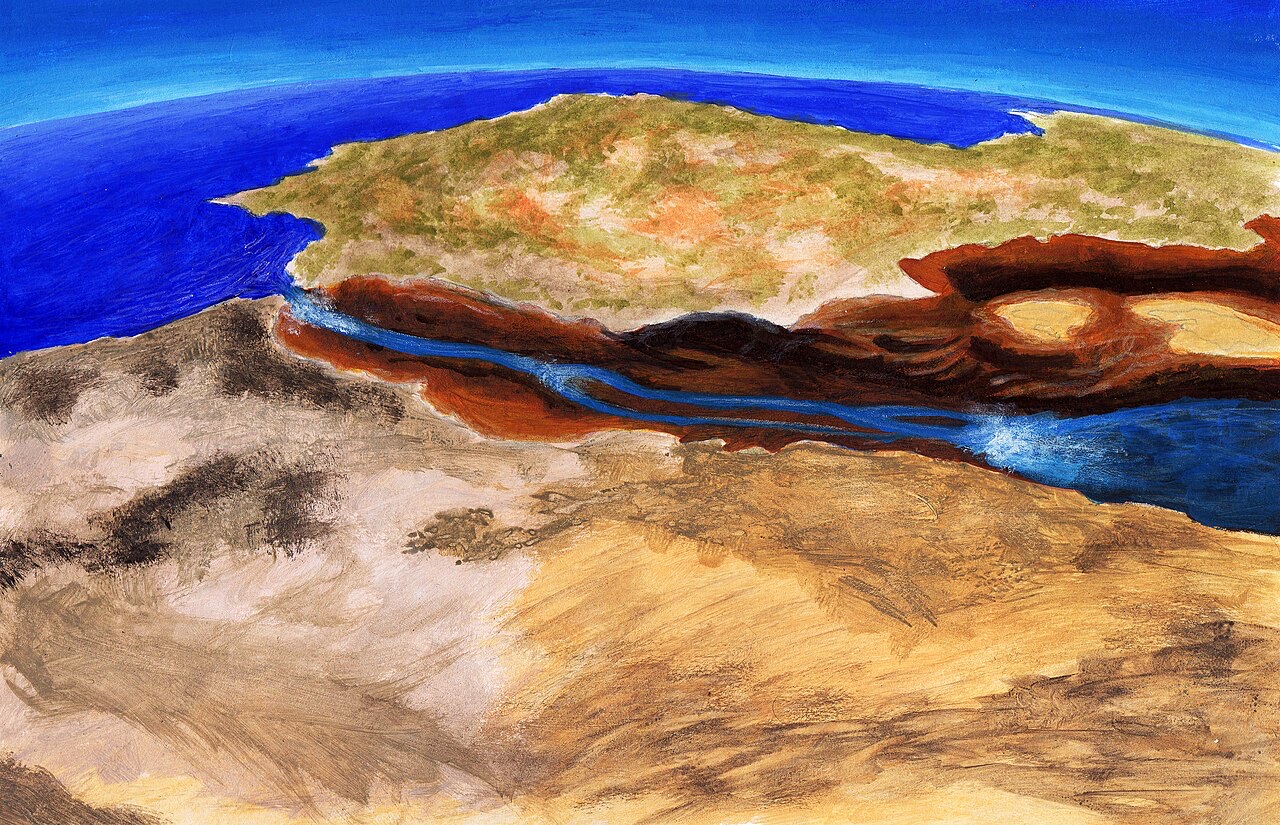
Between roughly 5.97 and 5.33 million years ago the Mediterranean was cut off from the Atlantic and lost most of its water to evaporation, leaving thick salt deposits, the Messinian Salinity Crisis. The refilling that ended it is the Zanclean flood, named for the earliest stage of the Pliocene.
In 2009 Daniel Garcia-Castellanos and colleagues published evidence in Nature for a catastrophic rather than gentle refill. A roughly 200-390 kilometre erosion channel runs from the Gulf of Cadiz across the Gibraltar sill into the Mediterranean, and modelling suggested discharge on an almost unimaginable scale, with water levels in the basin possibly rising many metres a day and a large fraction of the sea filling in perhaps months to a couple of years.
Later work, including studies seeking independent sedimentary evidence, has debated just how sudden the event was and how much of the fill was truly catastrophic. But the outline is widely accepted: an ocean poured through a broken sill and drowned a desert the size of a sea.
- Thick Messinian salt (evaporite) deposits beneath the Mediterranean record its near-desiccation before the flood.
- A large erosion channel crossing the Gibraltar sill, mapped by Garcia-Castellanos and colleagues (2009), records catastrophic incision.
- Hydraulic modelling reproduces extreme discharge capable of refilling much of the basin in a geologically short time.
- The Zanclean marks a sharp stratigraphic transition from evaporites to normal open-marine sediments.
- Micropalaeontology shows Atlantic marine life abruptly reoccupying the basin after the refill.
- Subsequent studies searching for sediment fans have tested and refined the sudden-flood model.