What archaeology says
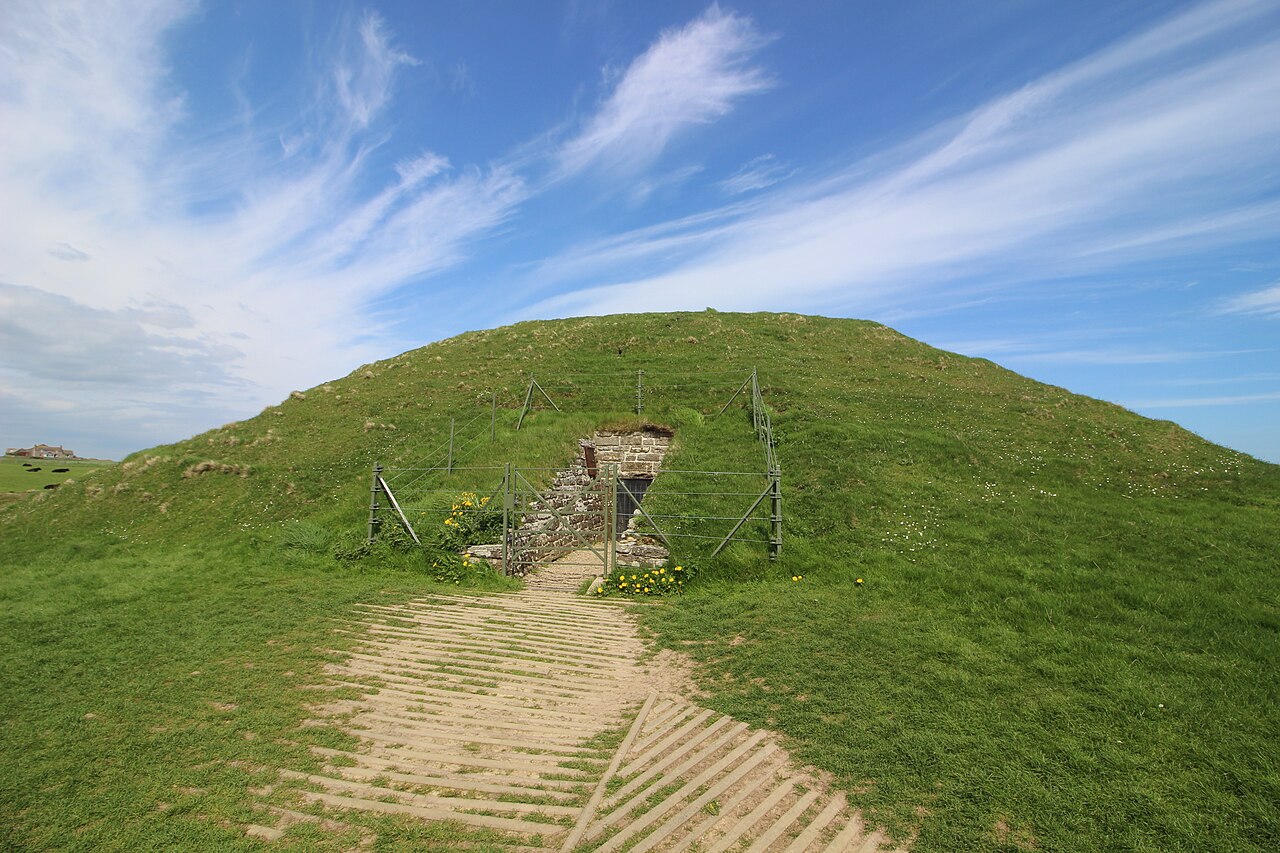
Maeshowe crowns the 'Heart of Neolithic Orkney' World Heritage landscape, which includes the Ness of Brodgar temple complex, Skara Brae village and the great stone circles. Its solstice alignment is accepted as intentional: the passage faces south-west towards the midwinter sunset, and the Barnhouse Stone, some 800 metres away, stands almost exactly on the alignment. Radiocarbon evidence and architectural parallels place construction around 2800 BC, with the mound built over an earlier structure — possibly itself ceremonial.
Archaeologists read the light-beam as ritual theatre binding the dead, the ancestors and the turning year: the sun 'dies' into the tomb at the year's darkest point and is reborn thereafter, a symbolism paralleled at Newgrange in Ireland, which admits the midwinter sunrise. The beam at Maeshowe operates over several weeks, arguing for a broad ceremonial season rather than a single calibrated day.
The Norse chapter is documented in the Orkneyinga Saga: crusaders sheltering from a storm around AD 1153 broke into 'Orkahaugr', and about 30 runic inscriptions plus a carved dragon record their boasts — of treasure taken, of women, and of who carved runes highest. What, if anything, they actually found inside remains unknown, as the chamber was empty when Victorian antiquarians entered in 1861.
- The passage orientation targets the midwinter setting sun, with the Barnhouse Stone marking the alignment externally
- Radiocarbon dating and architectural parallels place construction around 2800 BC within a rich ceremonial landscape
- Comparable solstice-lit tombs, above all Newgrange, show the design belongs to a wider Atlantic Neolithic tradition
- The Orkneyinga Saga's account of the break-in matches the physical evidence of forced entry through the roof
- About 30 twelfth-century runic inscriptions, the largest such collection outside Scandinavia, corroborate the Norse episodes