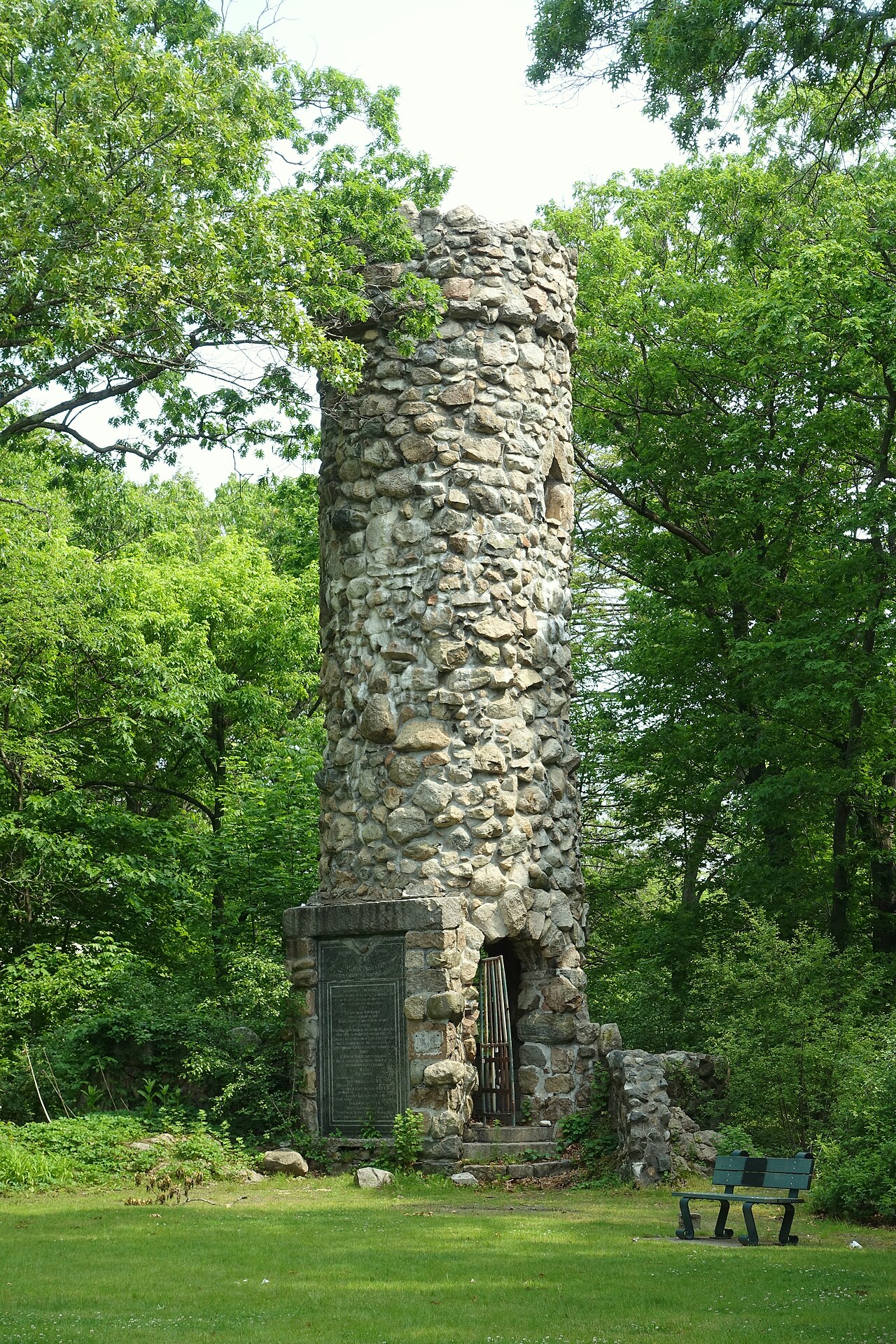
Lost Worlds · Norumbega Tower, Weston, Massachusetts, USA (Horsford's chosen site; the legend's usual anchor is the Penobscot River, Maine)

Norumbega

A phantom city that lived on maps for a century — then was reborn as a Viking capital by the man who invented modern baking powder.

Mainstream: 1529-1604 (rise and fall of the map legend)Alternative: c. AD 1000 (a Norse city of Leif Erikson, per Horsford)42.36°, -71.27°

At a glance

Norumbega
Photo: Daderot · Public domain

Norumbega was a name that grew in the telling. It first appears as Oranbega on the 1529 map of Girolamo da Verrazzano, apparently from an Eastern Algonquian word, and within decades European maps showed Norumbega as a great city of towers on the Penobscot River in Maine. The English sailor David Ingram, who claimed to have walked from the Gulf of Mexico to Nova Scotia in 1568-69, embroidered it with pillars of crystal and silver. When Samuel de Champlain explored the Penobscot in 1604-05 and found only forest and Wabanaki villages, the city died on the maps — but in the 1880s the Harvard chemist Eben Norton Horsford resurrected Norumbega as a lost Norse city on the Charles River in Massachusetts, and built a stone tower to mark the spot.

See it on the globe →
The mainstream view

What archaeology says

Historians treat cartographic Norumbega as a classic phantom: a real Algonquian place-name (possibly meaning quiet stretch of water) inflated by rumour, wishful geography and the era's hunger for another Mexico. Verrazzano's coastal reconnaissance of 1524 supplied the seed; the French pilot Jean Alfonse described a rich river and city in the 1540s; Ingram's tavern-worthy testimony, taken down for Sir Humphrey Gilbert's promoters in 1582, supplied crystal towers and rubies. Mapmakers such as Mercator and Ortelius dutifully engraved the city. Champlain's methodical survey of the Penobscot ended the affair: he reported no such city, and Norumbega faded to a regional label before vanishing.

The Viking revival is a separate, well-documented episode in American intellectual history. Eben Norton Horsford — the Rumford Professor at Harvard who made a fortune reformulating baking powder — became convinced that Norumbega derived from Norvega (Norway) and that Leif Erikson's Vinland lay on Massachusetts Bay. In a series of lavish self-published volumes (including The Discovery of the Ancient City of Norumbega, 1890) he located Leif's house on the Charles in Cambridge, identified stone walls and old dams in Watertown and Weston as Norse wharves and fish weirs, and in 1889 erected the 38-foot Norumbega Tower at the confluence of Stony Brook and the Charles in Weston to mark the Norse city and fort. He also funded Anne Whitney's statue of Leif Erikson, which still stands on Commonwealth Avenue in Boston.

Professional archaeologists found nothing Norse in any of it: Horsford's evidence consisted of colonial-era walls, dams and etymological free association. His campaign is now studied as part of the 19th-century Viking vogue, in which New England Protestants embraced a Norse discovery of America partly to trump Columbus. The only authenticated Norse site in North America remains L'Anse aux Meadows, Newfoundland, found in 1960 — and the only broadly accepted pre-Columbian Norse artefact from US soil is the Maine Penny, an Olaf Kyrre-era Norwegian coin reported from the Goddard site at Naskeag Point, Brooklin, Maine, in 1957, which mainstream opinion explains as an item traded down from Norse contact further north (if it is not a planted hoax).

Key evidence cited
  • Norumbega's cartographic life is fully documented, from Oranbega on the 1529 Verrazzano map through Mercator and Ortelius to its disappearance after 1600.
  • Champlain's 1604-05 exploration of the Penobscot found Wabanaki villages and no city, and he said so explicitly — the phantom died on contact with survey.
  • David Ingram's 1582 testimony, the main eyewitness source, is a hearsay narrative of a 3,000-mile walk, containing stock marvels (elephants, rubies) that discredit it.
  • Excavations have never produced Norse material anywhere in New England; Horsford's Norse wharves and walls are colonial and 19th-century features.
  • The only authenticated Norse site in the Americas is L'Anse aux Meadows, Newfoundland — far from the Charles River.
  • The Maine Penny's find context is unverifiable (a single finder's report from 1957), and identical Olaf Kyrre pennies circulated on the collector market at the time.
The alternative view

What the skeptics propose

The literalist case has two distinct wings. The first defends the maps: some antiquarians argued the 16th-century city was real — a substantial Wabanaki town, a lost European fishing colony, or a genuine native polity on the Penobscot whose decline (perhaps through epidemics that swept the coast before English settlement) erased it before Champlain arrived. On this reading, Ingram exaggerated but did not wholly invent, and the consistent placement of Norumbega on the Penobscot across dozens of independent maps reflects real reports of a real centre.

The second wing is Horsford's Norse thesis and its descendants. Horsford argued in earnest detail that Norumbega was Norse Norvega, that Vinland's landmarks matched Massachusetts Bay, and that thousands of Norse settlers had left dams, walls and canals along the Charles. Though professionally rejected even in his lifetime, his idea belongs to a durable family of New England Norse claims — the Newport Tower in Rhode Island (argued Norse by Philip Ainsworth Means and others, though dated by excavation to the 17th century), Leif's alleged camps on Cape Cod, and rune-stone claims along the coast.

Modern proponents of a Norse Norumbega lean hardest on the Maine Penny: a genuine Norwegian silver penny of Olaf Kyrre (minted c. 1065-1080), found — its finder Guy Mellgren said — in 1957 at a large Native trading site on Penobscot Bay, of all the bays in America the very one where the maps put Norumbega. If Norse voyagers or their goods reached Penobscot Bay, they argue, the Algonquian name and the map legend may both echo a real northern memory, exactly as Horsford intuited, however badly he argued it. Sceptics note such coins were purchasable in 1957 and the find context rests on Mellgren's word; the Maine State Museum nevertheless regards the coin itself as genuine and the trade-route explanation as most likely.

Key evidence cited
  • Dozens of independent 16th-century maps agree in placing a settlement called Norumbega on the Penobscot, which literalists read as convergent testimony rather than pure copying.
  • Jean Alfonse, an experienced royal pilot, described the river and its people from claimed first-hand knowledge in the 1540s.
  • The Maine Penny is accepted by the Maine State Museum as a genuine 11th-century Norwegian coin from a Penobscot Bay site — physical Norse-linked material in Norumbega's own bay.
  • The Goddard site's dating (c. 1180-1235) overlaps the coin's circulation period, and it held exotic trade items including Ramah chert from Labrador, proving long-range northern trade routes that could carry Norse goods south.
  • Horsford's core etymology (Norumbega from Norvega) was endorsed in his day by some European philologists he consulted, and the Norse presence in North America he championed was vindicated in principle at L'Anse aux Meadows.
  • Coastal epidemics of 1616-19 demonstrably erased large native communities before English eyes, showing how a substantial town could vanish between sighting and settlement.

Genuinely open questions

  1. What Algonquian word and what real place, if any, lie behind Oranbega/Norumbega?
  2. Is the Maine Penny a genuinely excavated trade item or a 1957 plant?
  3. How far south of Newfoundland did Norse voyages or Norse goods actually travel?
  4. Why did the Norumbega myth prove so useful to 19th-century New England elites, and what does that episode teach about motivated archaeology?

Worth knowing

Eben Norton Horsford funded his Viking obsession with baking powder: he made his fortune reformulating bread leavening (Rumford Baking Powder), then spent it on self-published Norumbega volumes, the stone Norumbega Tower in Weston, and Boston's statue of Leif Erikson — arguably the most lavish monument campaign ever mounted for a city that never existed.