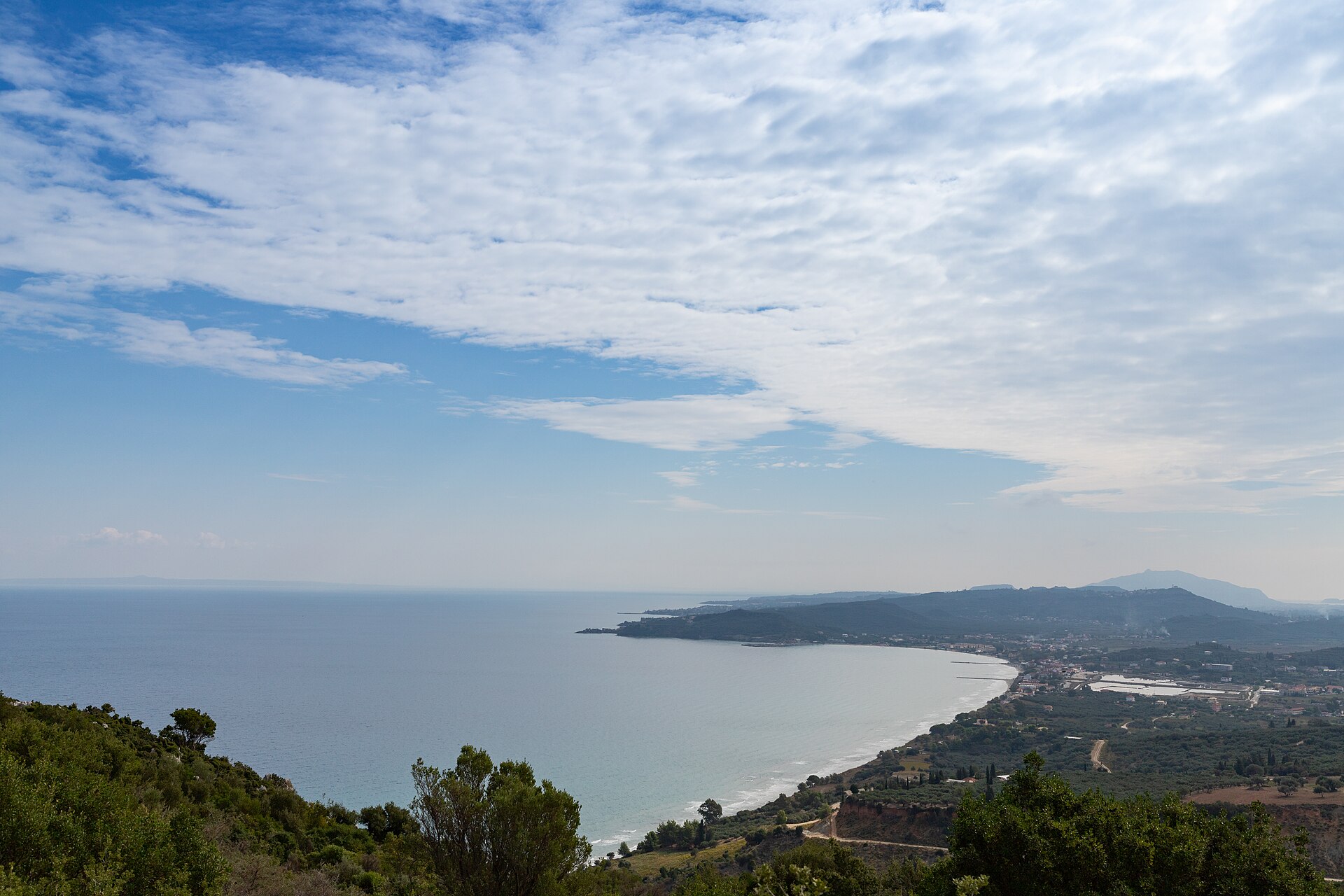
Lost Worlds · Alikanas Bay, Zakynthos, Greece

The Zakynthos 'Lost City'

It had column bases, paved floors and courtyard-like rings in shallow water — everything an ancient city needs, except any trace of humans.

Mainstream: Concretions formed by methane seeps in the Pliocene, up to c. 5 million years ago; exhumed on the modern seabedAlternative: Announced in 2013 as the possible remains of an ancient harbour city with columns and paved floors37.84°, 20.78°

At a glance

The Zakynthos 'Lost City'
Photo: dronepicr · CC BY 2.0

In 2013 snorkellers off Alikanas Bay on the Greek island of Zakynthos reported what looked unmistakably like a submerged ancient town in two to six metres of water: rows of circular 'column bases', doughnut-shaped rings, and broad slabs resembling paved floors, spread across an area of several hectares. Greece's Ephorate of Underwater Antiquities investigated, and for a while the find was discussed as public buildings of a lost harbour settlement. But the divers turned up not a single potsherd, coin or wall line — a silence that prompted a joint geological study by the University of Athens and the University of East Anglia. The 2016 verdict was elegant and deflating: the 'ruins' are natural mineral concretions formed around ancient methane seeps, millions of years before humans existed. The site has become the textbook example of how geology can counterfeit archaeology.

See it on the globe →
The mainstream view

What archaeology says

The investigation is a small model of how science should work. Because the visual resemblance to ruins was genuinely strong, the Greek authorities took the report seriously and put archaeologists in the water. What they found was suspicious in a different way: no ceramics, no amphora fragments, no anchors, no worked stone — nothing portable that every genuine ancient harbour site sheds in abundance. That absence triggered a mineralogical study led by Professor Julian Andrews of the University of East Anglia with Professor Michael Stamatakis of the University of Athens, published in 2016 in Marine and Petroleum Geology under a title that settled the matter: 'Exhumed hydrocarbon-seep authigenic carbonates from Zakynthos Island (Greece): Concretions, not archaeological remains'.

Microscopy, X-ray diffraction and stable isotope analysis showed the 'column bases' are made largely of dolomite — a mineral that rarely forms in normal seawater but is characteristic of microbe-rich, methane-charged sediments. The structures are the fossilised plumbing of hydrocarbon seeps: methane leaking up through a partially ruptured sub-seabed fault fed colonies of methane-oxidising microbes, whose chemistry cemented the surrounding sediment into concretions. Pipe-like conduits produced the 'columns', while broader cemented sheets became the 'pavements'; the linear arrangement that looked like town planning simply traces the fault. Later erosion exhumed the hard concretions from softer sediment, leaving them standing proud on the seabed like ruins. Similar seep concretions are well known from the North Sea and elsewhere — what is unusual at Zakynthos is that they formed in the Pliocene, up to five million years ago, and now sit in snorkelling depth where anyone can be fooled by them.

Key evidence cited
  • Complete absence of pottery, coins, anchors or any artefact across the whole site despite shallow, clear water
  • Dolomite mineralogy typical of microbial methane oxidation, not of any quarried building stone
  • Stable isotope signatures showing carbon sourced from hydrocarbon seeps
  • Alignment of concretions along a sub-seabed fault that channelled the escaping methane
  • Peer-reviewed 2016 study by Andrews and Stamatakis in Marine and Petroleum Geology
The alternative view

What the skeptics propose

The honest arc of this story is discovery, testing, and a natural explanation — and it is worth steelmanning why intelligent people believed in the city. Zakynthos lies in one of the most tectonically active corners of Europe, where real submerged and earthquake-shattered ancient sites are entirely plausible; the island had classical-era settlements and the sea level and land have shifted repeatedly. The shapes themselves are uncannily architectural: symmetric disks of consistent diameter aligned in rows genuinely do resemble the stumps of a colonnade, and cemented pavements look like nothing so much as flooring. The initial statement from the antiquities service treating them as possible public buildings was a reasonable first reading of visual evidence, not credulity. Some enthusiasts also noted the site could have fitted textual hints of lost harbours in the Ionian islands.

After 2016 a fringe of websites and documentaries continued to promote the 'lost city of Zakynthos', arguing that scientists were too quick to explain it away, or that dolomite concretions and ancient ruins could co-exist at the site. But no counter-analysis has ever been published: no artefact has been produced from the bay in more than a decade of easy, shallow-water access, and the geochemical fingerprint — dolomite precipitated by methane-oxidising microbes, with isotope values impossible for quarried building stone — has not been challenged in the literature.

For a site that turned out to be natural, Zakynthos earns its place in any fair-minded survey of sunken cities precisely because it calibrates the whole field. It demonstrates that 'it looks man-made' is a hypothesis, not a conclusion; that absence of artefacts is powerful negative evidence; and that the same tests that debunked Zakynthos are the ones that authenticated Thonis-Heracleion and Helike. Sceptics and alternative researchers alike can point to it: this is what it looks like when the process works.

Key evidence cited
  • Striking visual resemblance of the disks and rings to column bases and courtyard architecture
  • Cemented sheets closely mimicking man-made paved floors
  • Location in a seismically active region where genuinely submerged ancient sites are plausible
  • Initial assessment by the antiquities authorities treating the remains as possible public buildings
  • Classical-era settlement on Zakynthos, making a drowned harbour a reasonable prior expectation

Genuinely open questions

  1. Exactly when were the Pliocene concretions exhumed onto the modern seabed, and is the seep system fully extinct?
  2. How many other 'submerged ruins' reported worldwide are unrecognised seep concretions or beachrock?
  3. Could systematic survey around Zakynthos yet find genuine submerged antiquities of the historical era nearby?

Worth knowing

The 'lost city' of Zakynthos was built by microbes: methane-eating bacteria cemented the seabed into column-like concretions up to five million years ago — architecture finished several million years before the first humans walked the Earth.