Belief & Society · San Pablo Villa de Mitla, Oaxaca, Mexico

Mitla

The Zapotec place of the dead — with a sealed door to the underworld beneath a church

Mainstream: AD 900–1521 (Late Postclassic Zapotec, with Mixtec influence)Alternative: Entrance to Lyobaa sealed c. 16th century; deeper chambers of unknown age16.93°, -96.36°

At a glance

Mitla
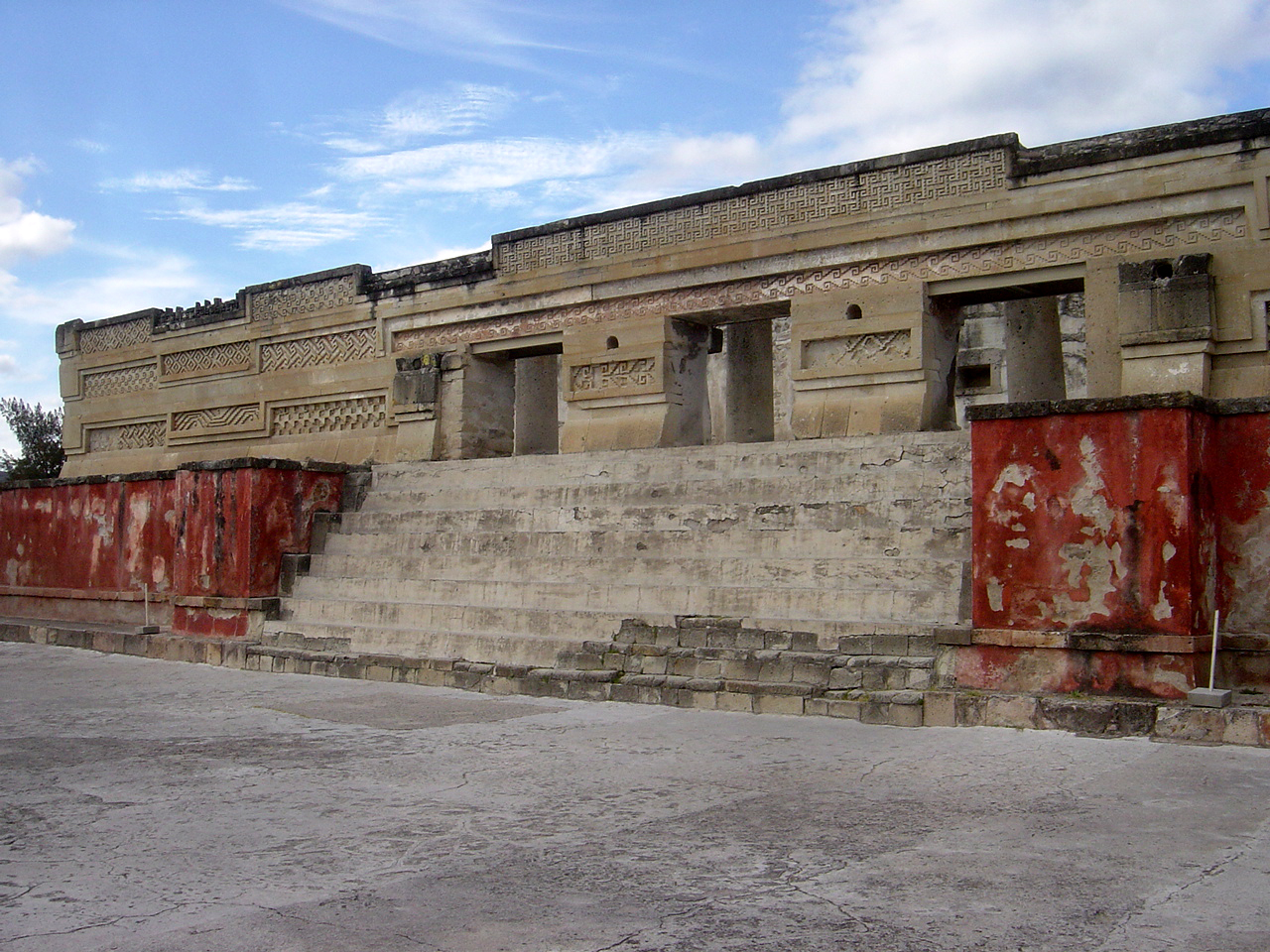
Photo: Bobak Ha'Eri · CC BY 2.0

Mitla, from the Nahuatl Mictlan, place of the dead, was the pre-eminent religious centre of the Zapotec people of Oaxaca, famed for palace walls covered in geometric fretwork mosaics assembled from thousands of precisely cut stones without mortar. Zapotec belief held that Mitla stood above Lyobaa, the resting place of the dead, and colonial chroniclers recorded that Spanish priests explored a vast subterranean complex beneath the temples before sealing its entrances in horror. In 2022 and 2023 the Lyobaa Project, a collaboration between Mexico's INAH, UNAM and the ARX Project, used geophysics to reveal genuine voids and passages beneath the site — including directly under the colonial church of San Pablo.

See it on the globe →
The mainstream view

What archaeology says

Archaeology places Mitla's grand surviving architecture in the Late Postclassic period, roughly AD 900 to the Spanish conquest, when it served as the seat of the Zapotec high priest, a figure the chronicles call the uija-tao. The five architectural groups, with their panels of stepped-fret mosaic in fourteen distinct geometric designs, represent the finest stone lattice work in Mesoamerica; cruciform subterranean tombs beneath the palaces are well documented and can be visited today. After the conquest, the Spanish built the church of San Pablo directly on top of the North Group's prehispanic platforms in the 16th century, a deliberate act of architectural supersession.

The story of a sealed underworld comes principally from the 17th-century Dominican chronicler Francisco de Burgoa, who wrote that friars entered a great underground chamber system — a common grave and shrine the Zapotecs regarded as the door to Lyobaa — found it foul and demon-haunted, and ordered the entrances walled up. Historians long treated this as embellished missionary rhetoric built on real but modest tombs.

The Lyobaa Project's results have made the question concrete. Non-invasive surveys using ground-penetrating radar, electrical resistivity tomography and seismic noise tomography in 2022 detected a large void beneath the church of San Pablo, on the order of 15 by 10 metres and beginning several metres down, apparently connected to deeper cavities, with two probable passages between about 5 and 8 metres deep. The 2023 season extended the survey and reported anomalies consistent with subterranean spaces under all the main architectural groups. INAH researchers stress that until anything is excavated, the voids' nature — natural caves, tombs, or a constructed complex — remains undetermined.

Key evidence cited
  • Documented cruciform tombs beneath the palace groups show Zapotec subterranean construction at the site
  • Lyobaa Project surveys (2022–23) by INAH, UNAM and ARX detected a void of roughly 15 by 10 metres beneath the San Pablo church, plus passages 5–8 metres down
  • The 2023 season found geophysical anomalies beneath all major architectural groups, suggesting connected subterranean spaces
  • Architecture and radiocarbon place the visible complexes in the Late Postclassic, AD 900–1521
  • Burgoa's 17th-century account is late, second-hand and written with missionary purpose
  • The Tlacolula valley's natural caves, including the UNESCO-listed prehistoric caves of Yagul and Mitla, offer a non-artificial explanation for voids
The alternative view

What the skeptics propose

For alternative researchers, the geophysics vindicates the chroniclers. Marco Vigato, founder of the ARX Project that co-sponsored the Lyobaa surveys and author of The Empires of Atlantis (2022), has argued that Mitla's legend of a great artificial underworld should be taken at face value: that beneath the Zapotec temples lies a genuine multi-level complex, the true Lyobaa, deliberately entombed by Spanish priests and never reopened. In this reading the church void is not a curiosity but the antechamber of the very entrance Burgoa described.

Writers in the tradition of 19th-century traveller Désiré Charnay and later popularisers have gone further, suggesting the deepest levels may predate the Postclassic Zapotecs altogether, pointing to the site's older occupation layers — Mitla was inhabited from at least 900 BC — and to the engineering sophistication of the fretwork palaces as evidence of inherited knowledge from an earlier era. Some link Mitla's underworld to wider Mesoamerican cave-cult networks, such as the tunnels beneath Teotihuacan.

Mainstream archaeologists welcome the survey data while rejecting the embroidery. They note that geophysical anomalies routinely turn out to be natural karst features — the Mitla region is riddled with caves considered prehistorically sacred — that Burgoa wrote decades after the alleged events with evangelising motives, and that nothing yet detected requires builders other than the Zapotecs, whose tomb-building beneath their palaces is a matter of record. The difference, both sides agree, is now testable by excavation.

Key evidence cited
  • Colonial chronicles explicitly describe friars entering a vast chamber system and sealing its entrances
  • The detected void lies directly beneath the church the Spanish built over the North Group — precisely where a sealed entrance would be expected
  • The church void appears connected to deeper, unexplored cavities
  • Zapotec religion consistently described Lyobaa as a real, enterable place beneath Mitla, not an abstraction
  • Occupation at Mitla reaches back to at least 900 BC, older than the standing palaces
  • Marco Vigato and the ARX Project argue only excavation, so far not permitted beneath the church, can rule the legend out

Genuinely open questions

  1. Are the voids beneath San Pablo natural karst, Zapotec tombs, or a larger constructed complex?
  2. Will INAH authorise excavation or endoscopic exploration beneath a functioning colonial church?
  3. Do the anomalies beneath the five architectural groups physically interconnect, as the underworld legend implies?
  4. How old is the earliest subterranean construction at Mitla?

Worth knowing

The geometric fretwork covering Mitla's palaces is estimated to contain on the order of 100,000 individually cut pieces of stone, fitted together without a dab of mortar — and not one of the fourteen repeating designs contains a curved line.