What archaeology says
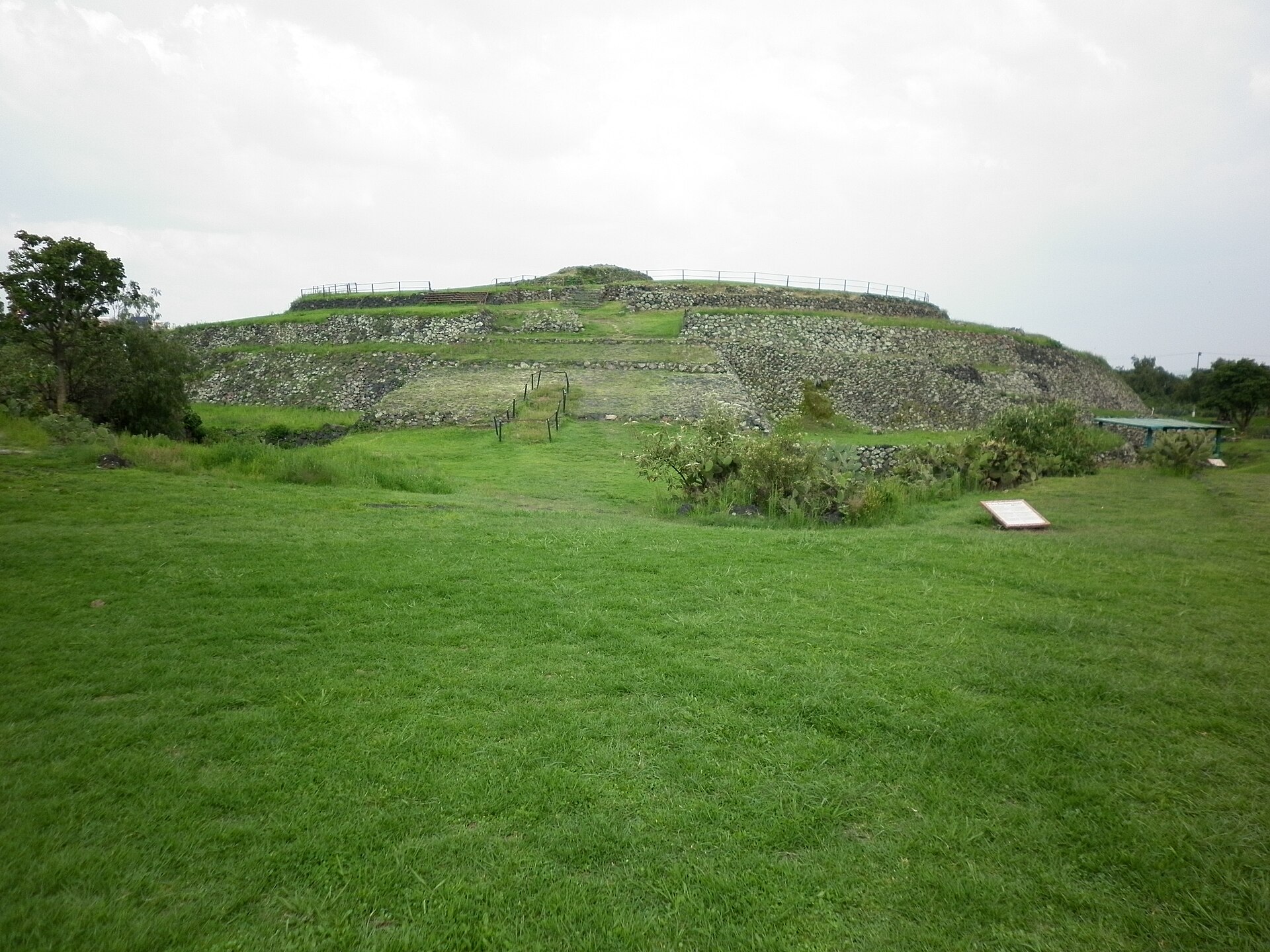
Cuicuilco was excavated from 1922 by Byron Cummings of the University of Arizona (with Manuel Gamio), and later by Eduardo Noguera and, in the 1960s, Heizer and Bennyhoff. The modern consensus, built on stratified ceramics and repeated radiocarbon campaigns, is that the pyramid was first raised around 800–600 BC in the Late Preclassic, enlarged in several stages to its final four-tiered form, and that Cuicuilco declined — probably in the face of Teotihuacan's rise, and possibly harried by ashfalls from Popocatépetl — before being definitively entombed by Xitle. A careful geological study by Claus Siebe (2000) radiocarbon-dated charcoal from directly beneath the lava to about 1,670 years before present, placing the eruption around AD 245–315 — and showing the city was largely abandoned before the lava came. The eruption's main victim was memory: Cuicuilco's refugees are thought to have swelled early Teotihuacan.
The site matters to archaeology as a 'missing link': its circular, tiered monumentality shows that large-scale civic-ceremonial construction was under way in the Basin of Mexico centuries before Teotihuacan, and its abandonment illustrates how volcanism repeatedly redirected Mesoamerican history. Salvage work since the 1990s — the site is now hemmed in by a shopping centre, office towers and the Olympic Village of 1968, whose construction destroyed outlying mounds — continues to refine the sequence, and a second radiocarbon series in the 1990s confirmed the conventional dates.
- Radiocarbon dates on the sub-lava sediments (c. 2,200 BP maximum), redone and confirmed in the 1990s
- Siebe's 2000 study dating the Xitle eruption to c. AD 245–315 from charcoal sealed beneath the lava
- Standard Late Preclassic ceramics throughout the construction fills and occupation layers
- Evidence the city was already declining before the eruption, consistent with Teotihuacan's contemporaneous rise
- Architectural parallels with other Preclassic circular platforms in central and western Mexico