What archaeology says
The Olmec were effectively rediscovered by Matthew Stirling, whose excavations at La Venta and Tres Zapotes between 1940 and 1943 (with Philip Drucker and Waldo Wedel, backed by the National Geographic Society) convinced a sceptical field that a sophisticated civilisation had flourished on the Gulf Coast long before the Maya. Radiocarbon dates published after Drucker's 1955 season bracketed La Venta's main occupation to roughly 900–400 BC, with the wider Olmec tradition beginning at San Lorenzo by about 1400–1200 BC. At a 1942 conference, Mexican archaeologist Alfonso Caso famously declared the Olmec the 'cultura madre' — mother culture — of Mesoamerica; scholars such as Kent Flannery and Joyce Marcus have since argued for 'sister cultures' developing in parallel, and that debate remains genuinely open within the discipline.
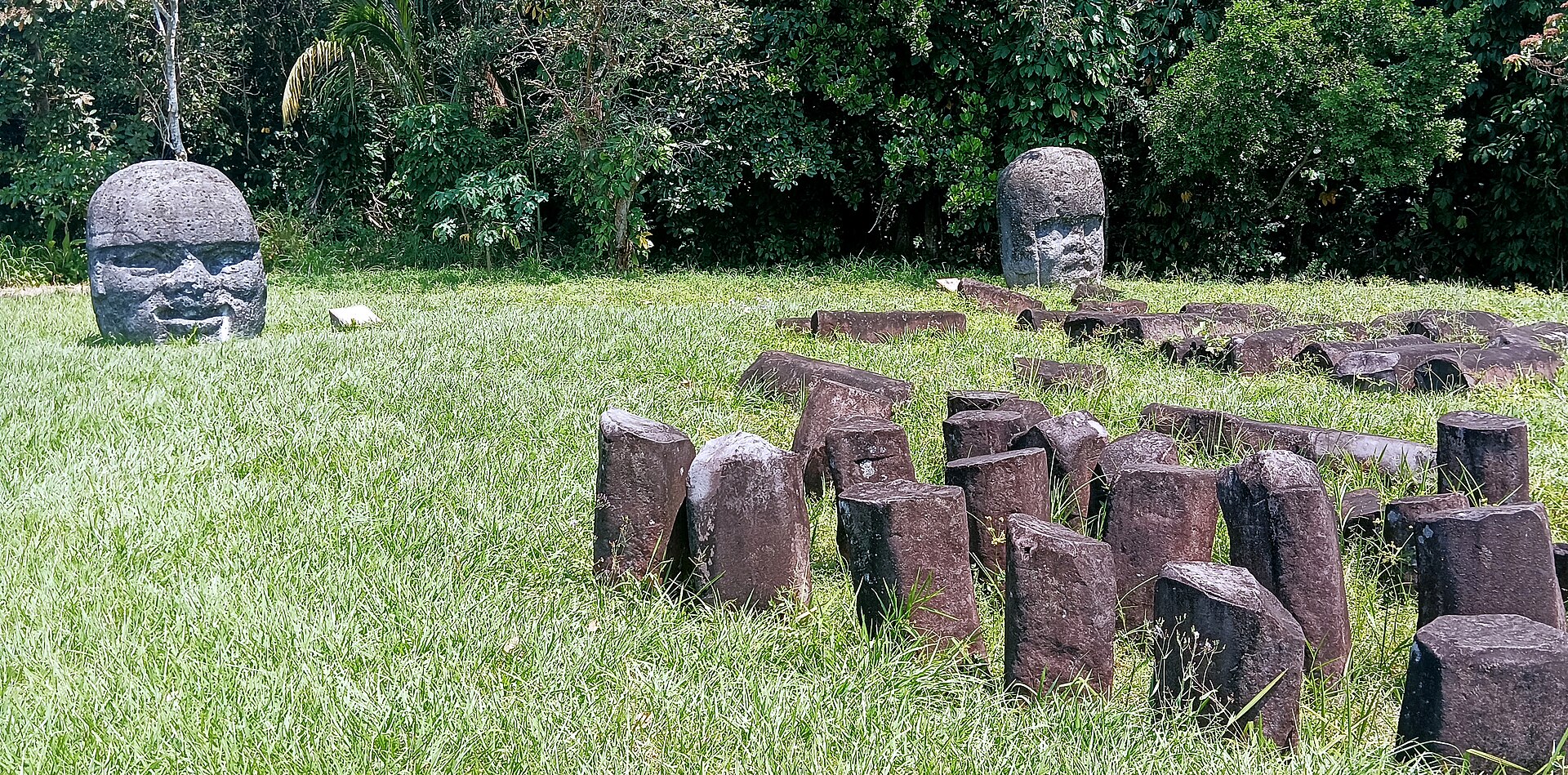
The colossal heads themselves are read as portraits of individual rulers, each wearing a distinctive helmet-like headgear, some apparently recarved from earlier throne monuments. The basalt came from the Cerro Cintepec area of the Tuxtla Mountains, in some cases moved 80–100 kilometres, presumably by raft and roller — a staggering logistical feat for a society without draught animals or the wheel. Complex A's buried offerings, including Massive Offering 3 with its 50 tonnes of finished serpentine sealed under thousands of tonnes of clay, show organised labour and ritual on a grand scale. On the question of who the Olmec were, the evidence is unambiguous to archaeologists: their art, iconography and material culture are continuous with earlier local traditions, and the living peoples of the Gulf Coast region share the broad facial features carved on the heads.
- Radiocarbon dates from La Venta and San Lorenzo placing the Olmec centuries before any proposed Old World contact
- Continuous local development of Olmec art and settlement from earlier Gulf Coast cultures
- Basalt sourced to the Tuxtla Mountains and worked with local techniques, some heads recarved from Olmec thrones
- No African artefact ever found in a controlled excavation in the pre-Columbian Americas
- No pre-Columbian African DNA detected in studies of Native American populations