Origins of Civilisation · Bay of Skaill, Orkney, Scotland

Skara Brae & the Ness of Brodgar

Europe's best-preserved Neolithic village — stone beds, dressers and drains from before the pyramids — beside a vast ceremonial 'temple complex'.

Mainstream: c. 3180–2500 BC (Skara Brae occupation); c. 3500–2300 BC (Ness of Brodgar complex)Alternative: Date not seriously disputed — sceptics instead ask why Neolithic Orkney was so precocious, proposing astronomer-priest elites (MacKie) or exotic long-range connections (Scranton)59.05°, -3.34°

At a glance

Skara Brae & the Ness of Brodgar
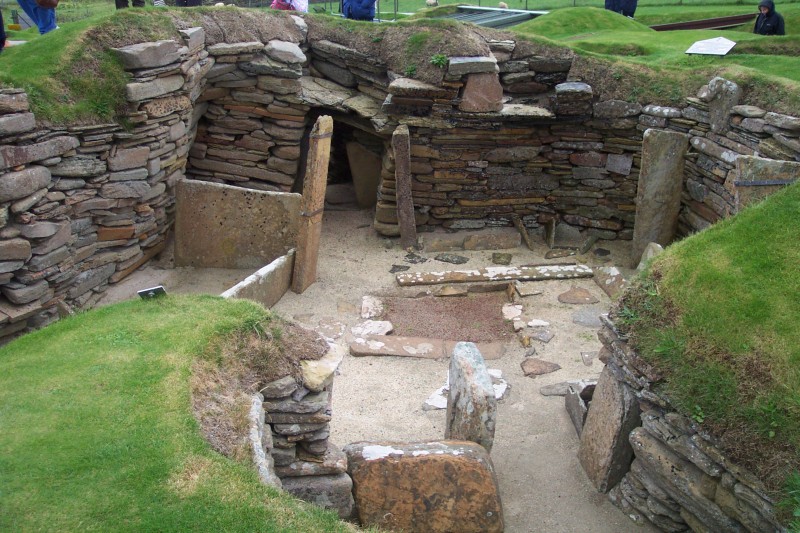
Photo: Dr. John F. Burka · CC BY-SA 3.0

Skara Brae is a cluster of ten semi-subterranean stone houses on the Bay of Skaill in Orkney, revealed when a great storm stripped the dunes in 1850. Each house preserves its stone furniture — box beds, a central hearth, a shelved 'dresser' facing the door — linked by low covered passages, with some houses even served by drains interpreted as indoor toilets. A few kilometres away, between the Ring of Brodgar and the Standing Stones of Stenness, excavation from 2004 to 2024 uncovered the Ness of Brodgar: a walled complex of monumental buildings, including the 25-metre 'Structure Ten', decorated stonework and painted walls, that has transformed understanding of Neolithic Britain. Together they anchor the Heart of Neolithic Orkney World Heritage site.

See it on the globe →
The mainstream view

What archaeology says

Skara Brae was first dug by the local laird William Watt after the 1850 storm and then scientifically excavated by V. Gordon Childe in 1928–30; Childe initially guessed an Iron Age date, but radiocarbon dating in the 1970s pushed occupation back to about 3180–2500 BC, making the village older than Stonehenge's sarsens and Egypt's pyramids. Its inhabitants were farmers, herders and fishers using Grooved Ware pottery — a style that apparently originated in Orkney and spread south through Britain — and crafting enigmatic carved stone balls and jewellery. The old story of a Pompeii-style abandonment in a single catastrophic sandstorm has given way to evidence of gradual decline as climate, sand encroachment and changing society ended the settlement.

The Ness of Brodgar excavations, directed by Nick Card, revealed something unprecedented: from about 3500 BC, generations of Orcadians built and rebuilt enormous stone halls with walls up to four metres thick, slate roofs, more than 1,000 examples of incised and pecked art, and Britain's earliest evidence of painted walls. Around 2400–2300 BC the great Structure Ten was decommissioned amid a feast involving several hundred cattle, and the complex was deliberately closed. With Maeshowe's midwinter-aligned chamber, the Stenness and Brodgar stone circles and villages like Barnhouse nearby, mainstream archaeology now sees Orkney not as a remote outpost but as a cultural powerhouse — plausibly an origin point for ideas, monuments and pottery styles that flowed south, a reversal of the old assumption that innovation travelled north. The final Ness season ran in summer 2024, after which the trenches were reburied for preservation, with limited new work prompted by geophysics planned for 2026.

Key evidence cited
  • Radiocarbon dates placing Skara Brae's occupation at c. 3180–2500 BC
  • Childe's 1928–30 excavations and later work by David Clarke documenting ordinary domestic middens and hearths
  • Twenty seasons at the Ness of Brodgar (2004–24) revealing monumental buildings, 1,000+ decorated stones and painted walls
  • Grooved Ware pottery originating in Orkney and spreading south, evidence of Orkney's cultural influence
  • The Structure Ten closing feast of several hundred cattle, radiocarbon dated to c. 2400–2300 BC
The alternative view

What the skeptics propose

Orkney's precocity invites bigger claims. The most substantial came from within archaeology: Euan MacKie proposed in the 1970s that Skara Brae was not an ordinary village but the residence of a privileged theocratic class of 'wise men' or astronomer-priests who ran ceremonies at the nearby circles — pointing to the village's unusual uniformity, its carved stone balls as possible insignia, and Alexander Thom's claim that the Ring of Brodgar was a precision lunar observatory laid out in megalithic yards. Graham and Anna Ritchie and later critics replied that the middens, dung, hearths and everyday rubbish of Skara Brae look exactly like ordinary domestic life, and MacKie's Maya-inspired model of a separate priestly caste found little evidential support; yet the later discovery of the Ness of Brodgar's monumental 'campus' between the circles has made the idea of a powerful ritual specialisation in Orkney look less far-fetched than it once did, even to sceptics.

Further out on the spectrum, author Laird Scranton (The Mystery of Skara Brae, 2016) argues the village's layout, symbols and traditions echo Gobekli Tepe, ancient Egypt and the cosmology of the Dogon of Mali, suggesting a common archaic source civilisation that seeded knowledge worldwide — a thesis mainstream archaeology rejects outright for want of any artefactual connection, noting that Orkney's material culture is demonstrably local and continuous. Catastrophist writers have likewise recycled the romantic image of villagers fleeing a sudden storm mid-meal (a necklace supposedly dropped in a doorway); modern excavation reads the evidence as slow abandonment, with the 'fleeing woman' a Victorian embellishment.

There is also a persistent popular claim that Skara Brae proves 'advanced' lost technology — central drainage, fitted furniture, even a form of toilet — beyond what Stone Age farmers should possess. Archaeologists counter that the sophistication is real but explicable: on a treeless island, flagstone splits naturally into building slabs, so carpentry solutions elsewhere executed in wood were here fossilised in stone — which is precisely why Skara Brae survives while thousands of contemporary wooden villages vanished.

Key evidence cited
  • MacKie's theocracy hypothesis: uniform housing, carved stone balls and proximity to major ceremonial circles
  • Thom's survey claiming the Ring of Brodgar functioned as a precision lunar observatory
  • Scranton's claimed symbolic parallels between Skara Brae, Gobekli Tepe, Egypt and Dogon cosmology
  • The sheer sophistication of drains, cells and fitted stone furniture in a 5,000-year-old village
  • Maeshowe's midwinter alignment and the Barnhouse Stone, showing real astronomical intent in the same landscape

Genuinely open questions

  1. What was the Ness of Brodgar complex actually for, and why was it ritually closed with a massive cattle feast around 2300 BC?
  2. What do the carved stone balls and repeated geometric motifs of Neolithic Orkney mean?
  3. Why did tiny, treeless Orkney become a cultural centre whose ideas apparently spread south across Britain?

Worth knowing

Some houses at Skara Brae had small cells built over drains that archaeologists interpret as indoor toilets — meaning Orkney villagers may have enjoyed en-suite plumbing roughly 4,500 years before it reached most British homes.