Belief & Society · Palpa, Ica Region, southern Peru

The Palpa Lines

Older than Nazca and carved on hilltops instead of plains — the geoglyphs that quietly rewrote the story of Peru's most famous lines.

Mainstream: c. 400 BC – AD 1 (Paracas and Topara cultures, predating most Nazca figures)Alternative: Date not seriously disputed — the significance is that they are older than Nazca, which mainstream research affirms-14.54°, -75.19°

At a glance

The Palpa Lines
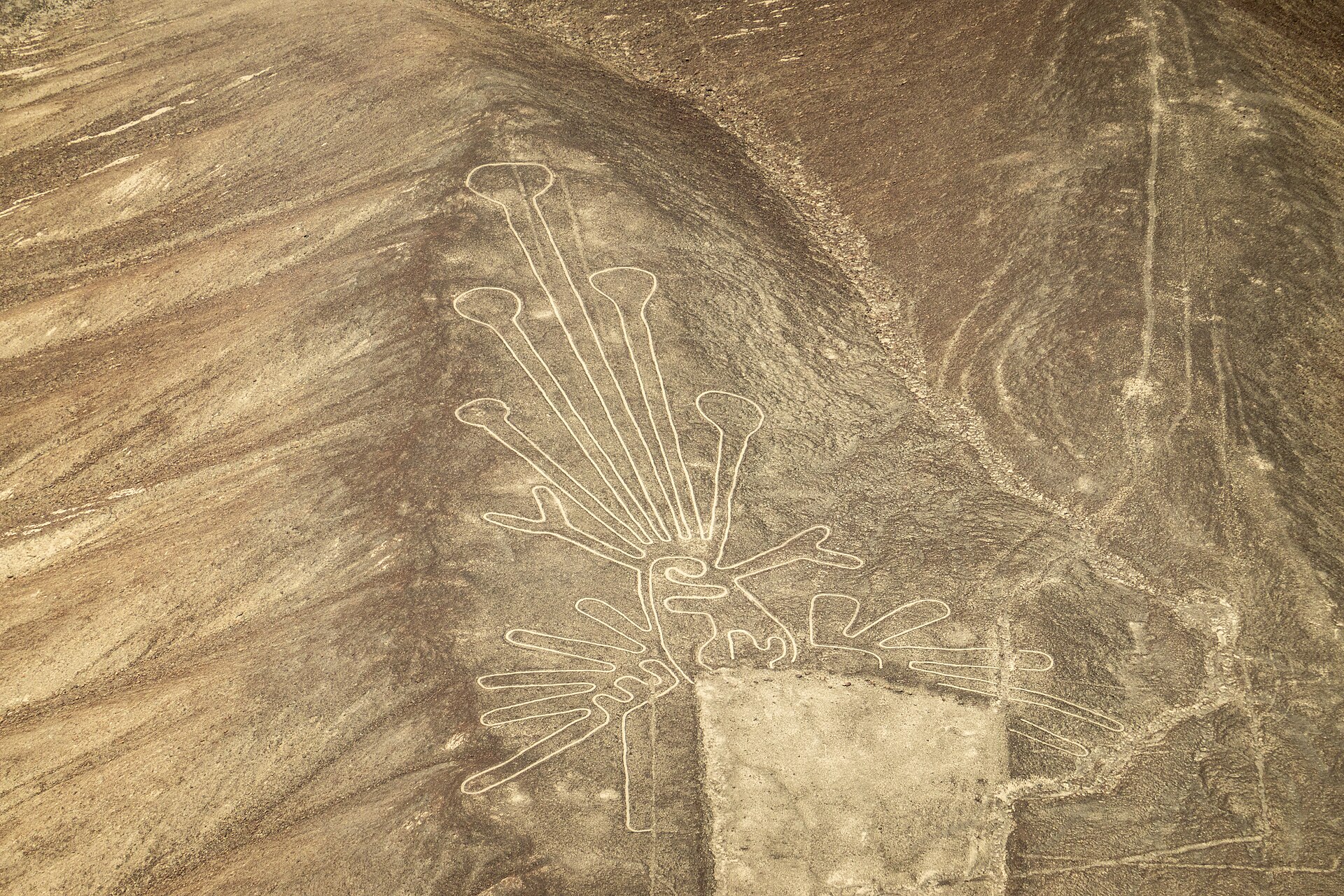
Photo: PsamatheM · CC BY-SA 4.0

Around the town of Palpa, a short distance north of Nazca in Peru's Ica Region, the desert hills carry their own dense population of geoglyphs — and they are, on current evidence, older than their world-famous neighbours. More than a thousand figures and lines have been recorded on the slopes, ridges and plateaux around Palpa, including anthropomorphic figures, animals and geometric forms, together with a celebrated hillside feature known locally as the Reloj Solar, or 'Solar Clock', whose lines are said to mark seasonal or equinoctial change. The crucial difference from Nazca is placement. Most Nazca figures lie on the flat desert plain and read best from the air, which is precisely what fed a century of speculation about who they were 'for'. The Palpa geoglyphs, by contrast, tend to sit on hilltops and hillsides, angled to be seen by people standing in the valleys and villages below. That shift — from figures addressed to the sky to figures addressed to a human audience — is central to what makes Palpa important, because it reframes how and why this whole tradition of desert art began.

See it on the globe →
The mainstream view

What archaeology says

The Palpa geoglyphs have been the focus of long-term, systematic research, above all by Markus Reindel and Johny Isla of the German Archaeological Institute (later joined by drone-survey work with Masato Sakai of Yamagata University). Beginning in the 1990s, their teams documented and excavated hundreds of sites and established a developmental sequence: many Palpa figures were made by the Paracas and Topara cultures, roughly between 400 BC and the turn of the era, which places them earlier than the majority of the classic Nazca-plain geoglyphs. Peru's Ministry of Culture likewise attributes the Palpa geoglyphs to the Paracas and Topara peoples of that early window.

This earlier, hillside phase reshapes the Nazca story. It shows that the tradition did not begin with vast figures aimed at the heavens but with images placed for terrestrial viewers — set on slopes above settlements, depicting human and mythical figures in a style continuous with Paracas iconography seen on textiles and pottery. From that foundation the practice appears to have shifted, in the later Nazca period, onto the open plain and toward the enormous line-and-figure geoglyphs that made the region famous. The Reloj Solar and similar features fit a broader interpretation of the geoglyphs as bound up with ritual, water and agricultural fertility in an intensely arid land — concerns for which archaeologists such as Reindel and Isla have argued the lines were walked, gathered at and maintained as part of ceremonial life.

In short, mainstream research treats Palpa not as a lesser annex of Nazca but as its older root — the phase that reveals where the whole extraordinary tradition came from.

Key evidence cited
  • Decades of survey and excavation at Palpa by Markus Reindel and Johny Isla of the German Archaeological Institute
  • Attribution of many figures to the Paracas and Topara cultures (c. 400 BC – AD 1), earlier than most Nazca geoglyphs
  • Hilltop and hillside placement angled toward valley settlements, showing they were made for ground-level human viewers
  • Iconographic continuity with Paracas textiles and pottery anchoring the figures in a known cultural sequence
  • A developmental sequence linking early hillside figures to the later flat-plain Nazca tradition
The alternative view

What the skeptics propose

Palpa is less encrusted with fringe theory than Nazca, but it inevitably shares in it. Because the two lie side by side and belong to one tradition, the ancient-astronaut and lost-civilisation claims made famous about Nazca — that the figures were runways, signals or messages for beings who viewed them from above — are routinely extended to Palpa, and its hillside figures and the Reloj Solar are folded into the same 'unexplained mysteries' narrative. Some popular accounts also read specific Palpa designs as encoding advanced astronomical or geometric knowledge, or draw loose comparisons between their forms and symbols from other continents.

Steelmanning the interest: Palpa does raise real and legitimate questions. The Reloj Solar's reported alignment with seasonal or equinoctial events is a serious hypothesis about ancient sky-watching, and the effort invested in so many hillside figures clearly reflects deep purpose rather than idle decoration. Those are proper subjects of study, and the fascination they provoke is understandable.

But Palpa is also, quietly, one of the strongest rebuttals to the aerial-viewer theories that swirl around Nazca. Precisely because the Palpa geoglyphs are older and sit on hillsides angled toward people below, they demolish the premise that these images could only have been meant for eyes in the sky: here is the parent tradition, made expressly to be seen from the ground by the communities that built it. The German Archaeological Institute's decades of dated, excavated, iconographically anchored work leave no room for lost civilisations or extraterrestrial patrons. The genuinely exciting revision — that Nazca grew out of an older, human-facing Paracas practice at Palpa — is a discovery of ordinary archaeology, and it makes the aerial-mystery framing look not just unnecessary but backwards.

Key evidence cited
  • Extension of Nazca's ancient-astronaut 'runway / signal' claims to the neighbouring Palpa figures
  • The Reloj Solar read as encoding calendrical or equinoctial astronomical knowledge
  • Claims that certain Palpa designs hold advanced geometric or astronomical information
  • Loose comparisons drawn between Palpa motifs and symbols from other ancient cultures
  • Inclusion of Palpa within the broader 'unexplained mysteries' framing built around Nazca

Genuinely open questions

  1. How precisely can individual Palpa geoglyphs be dated, and how sharp is the transition from hillside Paracas figures to plain-based Nazca ones?
  2. Does the Reloj Solar genuinely encode a calendrical or equinoctial function, or is that a modern interpretation?
  3. How did the shift from ground-facing hillside images to sky-facing plain figures reflect changes in Nazca-region society and religion?

Worth knowing

The Palpa geoglyphs quietly undercut the whole 'made for aliens in the sky' idea about Nazca — being older and set on hillsides to face the villages below, they show the tradition began as art meant for people standing on the ground.