Origins of Civilisation · Iron Gates gorge, Danube, Serbia

Lepenski Vir

Europe's strangest Stone Age village: trapezoidal houses on the Danube guarded by bug-eyed fish-human idols.

Mainstream: c. 9500–5500 BC, main sculpture phase c. 6200–5900 BCAlternative: Claimed as evidence of a forgotten Danubian civilisation, its fish-beings read by some as memories of Oannes-like teachers44.56°, 22.02°

At a glance

Lepenski Vir
Photo: Wikimedia Commons · CC BY 3.0

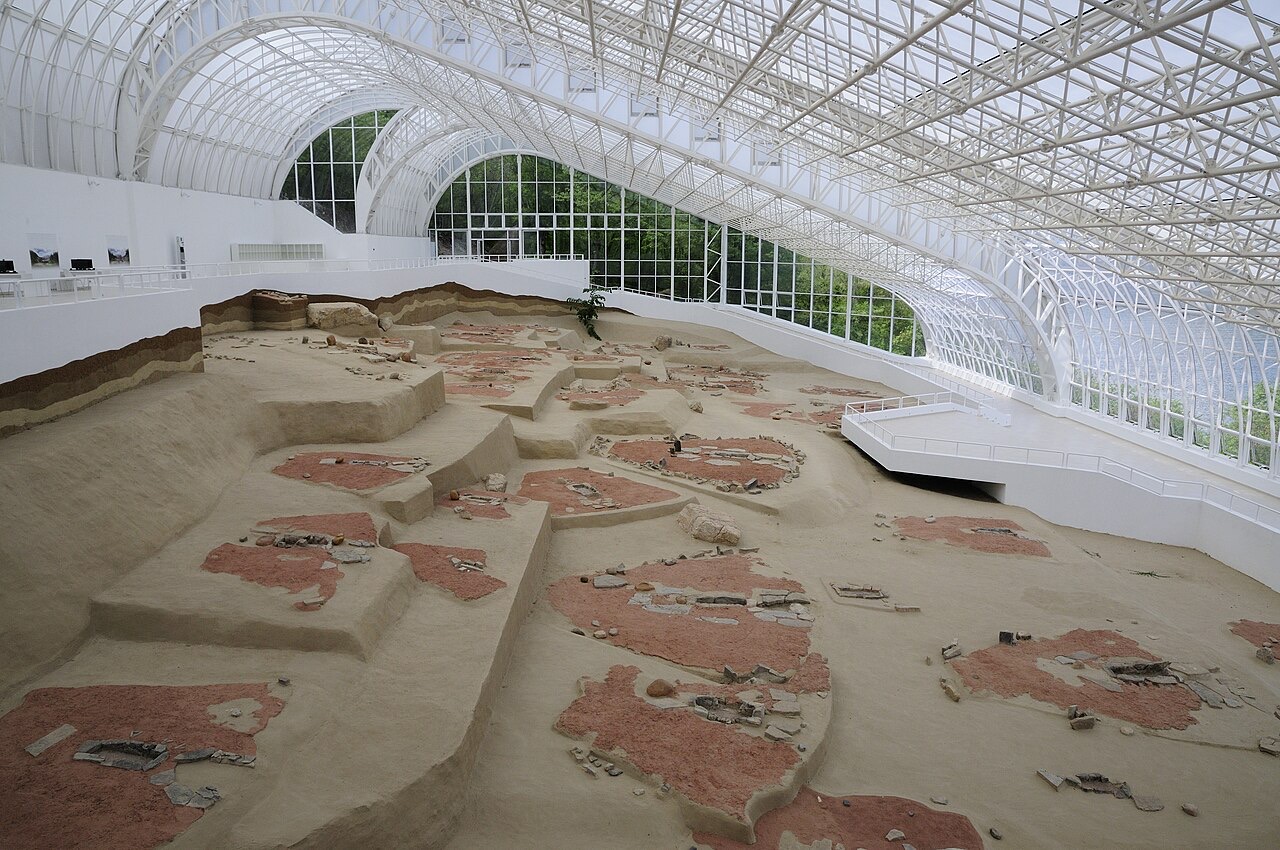
Lepenski Vir sits on a horseshoe terrace above a whirlpool of the Danube in the Iron Gates gorge, where the river cuts between Serbia and Romania. Excavated by Dragoslav Srejović of Belgrade University between 1965 and 1970, ahead of the Đerdap dam, it revealed a planned Mesolithic-to-Neolithic settlement of trapezoidal buildings with hard limestone-plaster floors, central stone-lined hearths, and dozens of sandstone boulders carved into staring hybrid fish-human faces — the oldest monumental sculpture in Europe, made by complex fisher-forager communities up to 9,500 years ago. The site was relocated 30 metres uphill under a protective canopy before the reservoir rose.

See it on the globe →
The mainstream view

What archaeology says

Mainstream archaeology regards Lepenski Vir as the flagship of the Iron Gates Mesolithic, a rare case of sedentary or semi-sedentary hunter-fisher communities building durable architecture long before, and then during, contact with farming. The economy leaned heavily on the river: beluga sturgeon, catfish and carp, confirmed by isotopic studies of human bone by researchers such as Clive Bonsall, which show strongly aquatic diets. The trapezoid buildings, their floors of burnt-lime plaster and their proportions repeated from house to house, indicate shared architectural rules sustained over generations.

Modern radiocarbon programmes have refined Srejović's original sequence: the terrace was used from around 9500 BC, while the iconic phase with the sculpted boulders and standardised trapezoidal buildings clusters around 6200-5900 BC — exactly when the first Neolithic farmers were arriving in the Danube gorges. Ancient-DNA studies published in the 2020s show local foragers and incoming Anatolian-ancestry farmers meeting, mixing and sometimes being buried under the same floors.

The fish-faced boulders, some combining human mouths and eyes with fish attributes, are usually interpreted through Srejović's own lens: ancestor figures or river deities of a fishing people, perhaps mediating a worldview in which humans and the great sturgeon of the Danube shared essence. Burials beneath house floors reinforce the reading of houses as ritual as well as domestic spaces.

Key evidence cited
  • Radiocarbon dates spanning c. 9500-5500 BC, with the sculpted-boulder phase at c. 6200-5900 BC
  • Isotope analyses showing diets dominated by Danube fish, especially sturgeon
  • Fifty-plus carved sandstone boulders, the oldest monumental sculpture in Europe, found mostly around house hearths
  • Standardised trapezoidal buildings with limestone-plaster floors implying strong shared building traditions
  • Burials beneath floors linking houses to ancestor ritual
  • Ancient DNA demonstrating interaction between local foragers and incoming Anatolian farmers
The alternative view

What the skeptics propose

Because nothing quite like it exists anywhere else, Lepenski Vir attracts bolder readings. Ancient-astronaut writers, following the trail blazed by Erich von Däniken and rehearsed on the television series Ancient Aliens, have connected the fish-human sculptures to the Mesopotamian tradition of Oannes, the amphibious sage said by the Babylonian priest Berossus to have taught humanity the arts of civilisation — asking whether both preserve memories of the same non-human visitors. The staring lidless eyes and down-turned mouths of the boulders do bear a striking, if superficial, resemblance to later Apkallu fish-sage imagery.

A second alternative current, strong in the Balkans, folds Lepenski Vir into a claimed 'Danube civilisation' — the argument that the Danube basin, from Lepenski Vir through Vinča, hosted the true cradle of European civilisation, complete with proto-writing, millennia before Mesopotamia. Serbian authors in the tradition of Radivoje Pešić present the site as the fountainhead of that lost world.

Within academia itself there are genuine disputes that echo the wilder claims in muted form: whether the trapezoidal structures were dwellings at all or primarily shrines; whether the settlement's geometry deliberately mirrors the trapezoid mountain of Treskavac across the river; and how a forager society achieved such architectural formality. Srejović himself called the site proof that the Danube gorges were a cradle of European culture — a phrase alternative writers quote with enthusiasm.

Key evidence cited
  • Hybrid fish-human idols visually echoing the Mesopotamian Oannes and Apkallu fish-sages, as ancient-astronaut writers note
  • Architecture of striking geometric regularity from a supposedly simple forager society
  • The settlement plan appears oriented on the trapezoidal mountain Treskavac, hinting at deliberate cosmological design
  • Claimed continuity from Lepenski Vir through Vinča as a single lost Danubian civilisation
  • The uniqueness of the site — no close parallel exists anywhere in prehistoric Europe
  • Srejović's own description of the gorges as an independent cradle of European culture

Genuinely open questions

  1. Were the trapezoidal structures houses, shrines, or both at once?
  2. What did the fish-human boulders mean to the people who carved them?
  3. Why does the architectural template appear, flourish and vanish within a few centuries?
  4. How exactly did forager Lepenski Vir absorb, resist or transform the arriving Neolithic?

Worth knowing

The whole settlement was sawn from its terrace and moved 30 metres uphill in 1971 to save it from the rising Đerdap reservoir — visitors today walk through the original floors, relocated under a vast glass canopy.