Myth & Memory · Candidate site: Cadbury Castle, Somerset, England

Camelot & Cadbury Castle

Camelot began as a French poet's invention — yet the Somerset hill long called Arthur's turned out to hide a genuine Dark Age citadel.

Mainstream: Hillfort massively refortified c. AD 470–580; 'Camelot' first named in literature by Chretien de Troyes, c. AD 1180Alternative: Identified as Arthur's Camelot since John Leland's visit of 1542; proposed as the real stronghold of a late 5th-century British war leader51.02°, -2.53°

At a glance

Camelot & Cadbury Castle
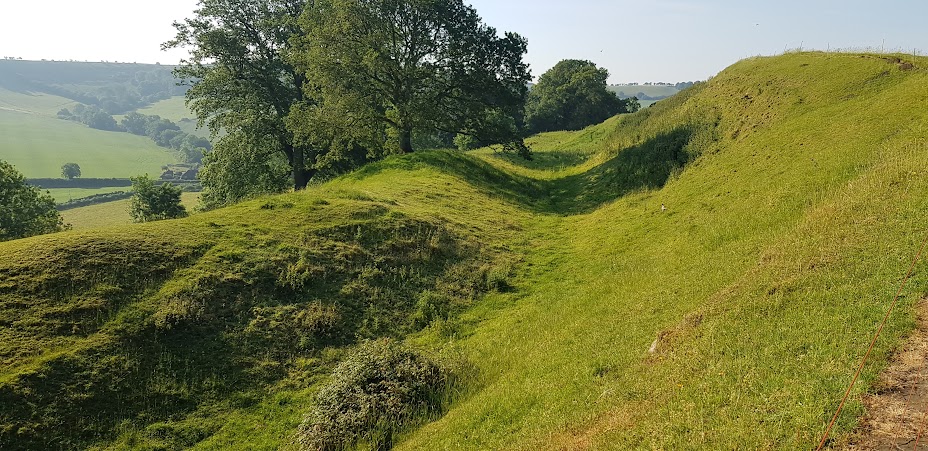
Photo: Hellowikieditor · CC0 1.0

Camelot, King Arthur's storied court, entered literature in the French romances of Chretien de Troyes around 1180 and has no fixed address in any early source. But since the Tudor antiquary John Leland wrote in 1542 that the people of South Cadbury 'have heard say that Arturre much resorted to Camalat', one candidate has towered over the rest: Cadbury Castle, a great four-ramparted Iron Age hillfort crowning a limestone hill in Somerset, within sight of Glastonbury Tor. Excavations in the 1960s made it world-famous by revealing that, at exactly the right time for a historical Arthur-figure, the derelict fort was re-armed on a scale unmatched anywhere in post-Roman Britain. Rival claimants for Camelot include Tintagel, Caerleon and Winchester.

See it on the globe →
The mainstream view

What archaeology says

The Camelot Research Committee excavations of 1966–1970, directed by Leslie Alcock, remain among the most celebrated digs in British archaeology. Beneath the Iron Age defences Alcock found that around AD 470–580 the entire 1.2-kilometre perimeter of the innermost rampart had been rebuilt with a timber-framed, stone-filled fighting wall, pierced by a gate-tower — a refortification demanding resources and manpower on a scale implying a major regional ruler. On the summit plateau stood a timber feasting hall of about 20 by 10 metres, and the site yielded quantities of imported Mediterranean amphorae and fine wares, evidence of elite trade reaching Byzantium. Whoever held Cadbury around AD 500 commanded wealth and warriors: the archaeology is not in dispute.

The retreat has been from the name. Alcock himself, initially open to a historical Arthur in his 1971 book Arthur's Britain, grew steadily more cautious, and by his definitive 1995 site report he analysed 'Cadbury/Camelot' purely as the citadel of an anonymous British potentate. Historians such as Nicholas Higham and Guy Halsall have since argued that the case for any historical Arthur rests on sources written centuries after the events, and that Camelot itself is a 12th-century French literary invention that no archaeology could ever locate. On this view Leland's 1542 identification reflects Tudor folklore — helped along by the nearby River Cam and the villages of Queen Camel and West Camel — rather than surviving ancient memory. The mainstream position is thus a curious split: Cadbury's Dark Age citadel is real and remarkable; its connection to Arthur is unprovable and its connection to 'Camelot' anachronistic by definition.

Key evidence cited
  • Camelot is absent from all early Arthurian sources; it first appears in Chretien de Troyes, c. 1180
  • Alcock's excavations dated Cadbury's great refortification to c. AD 470–580 on stratigraphy, finds and radiocarbon
  • The 20 x 10 metre timber hall and gate-tower attest an anonymous elite, with no inscription naming any ruler
  • Leland's 1542 identification is the earliest record linking Cadbury to Camelot, plausibly inspired by local Cam- place-names
  • Higham's and Halsall's source-criticism finds no contemporary evidence for a historical Arthur at all
The alternative view

What the skeptics propose

Defenders of the identification argue the convergence is too neat to dismiss. Camelot may be a romance name, but romances often encode older tradition, and Cadbury is precisely what the legend requires: the largest and most heavily refortified stronghold of exactly the period in which the Welsh annals and battle-lists place Arthur's career, sited in the West Country where Arthurian topography clusters most densely. Local folklore recorded long before modern archaeology — Arthur sleeping inside the hollow hill, his knights riding out on midsummer eve, the track to Glastonbury called Arthur's Lane — suggests, believers argue, a tradition attached to the hill rather than invented by Leland. Writers such as Geoffrey Ashe, a founding member of the Camelot Research Committee, maintained that the excavations effectively vindicated the folklore: someone of Arthur's stature held Cadbury at Arthur's time, and 'Camelot' is as good a name for the historical original as any.

Rival candidates keep the argument alive. At Tintagel in Cornwall — Arthur's legendary conception-place — excavations by Rachel Barrowman in the 1990s and by Jacky Nowakowski's Cornwall Archaeological Unit team for English Heritage in 2016–2017 revealed a dense 5th–7th century citadel with the richest Mediterranean import assemblage in Britain, plus the 1998 'Artognou' slate bearing a Brittonic name tantalisingly (if, epigraphers insist, coincidentally) reminiscent of Arthur. Geoffrey of Monmouth located Arthur's plenary court at Caerleon's Roman fortress in Wales, whose amphitheatre was locally the 'Round Table'; Malory preferred Winchester; and Chester's amphitheatre has had modern champions. Each candidacy implicitly concedes the sceptics' point — that Camelot is wherever the story-tellers put it — while insisting the story had somewhere real to start.

Key evidence cited
  • Cadbury's post-Roman refortification is the largest known in Britain, fitting a paramount war leader c. AD 500
  • Mediterranean amphorae and fine wares show the site's lord traded with the Byzantine world, as Tintagel's did
  • Pre-excavation folklore (the hollow hill, Arthur's Lane, midsummer rides) attached Arthur to the hill centuries before archaeology
  • The Tintagel citadel and Artognou stone prove the legend's landscapes held genuine high-status Dark Age centres
  • Geoffrey Ashe's argument: the excavation found exactly what the tradition, taken seriously, predicted

Genuinely open questions

  1. Who was the ruler wealthy enough to refortify Cadbury's entire perimeter around AD 500?
  2. Did Leland record genuine surviving folk tradition in 1542, or a recent antiquarian guess from suggestive place-names?
  3. Why did major refortification of old hillforts happen at Cadbury on a scale seen nowhere else in post-Roman Britain?

Worth knowing

Cadbury villagers told 16th-century visitors the hill was hollow and Arthur slept inside; when Alcock's team arrived in 1966, one local reputedly asked whether they had come to dig up the king.