Belief & Society · Cerne Abbas, Dorset, England

Cerne Abbas Giant

Britain's most famous naked hill figure fooled everyone — the 2021 dating showed the prehistoric camp and the Cromwell-satire camp were both wrong.

Mainstream: AD 700–1100 (late Saxon, OSL dating 2021)Alternative: Iron Age fertility god, Roman-era Hercules, or 17th-century satire — the three rival camps all pre-dating the 2021 results50.81°, -2.47°

At a glance

Cerne Abbas Giant
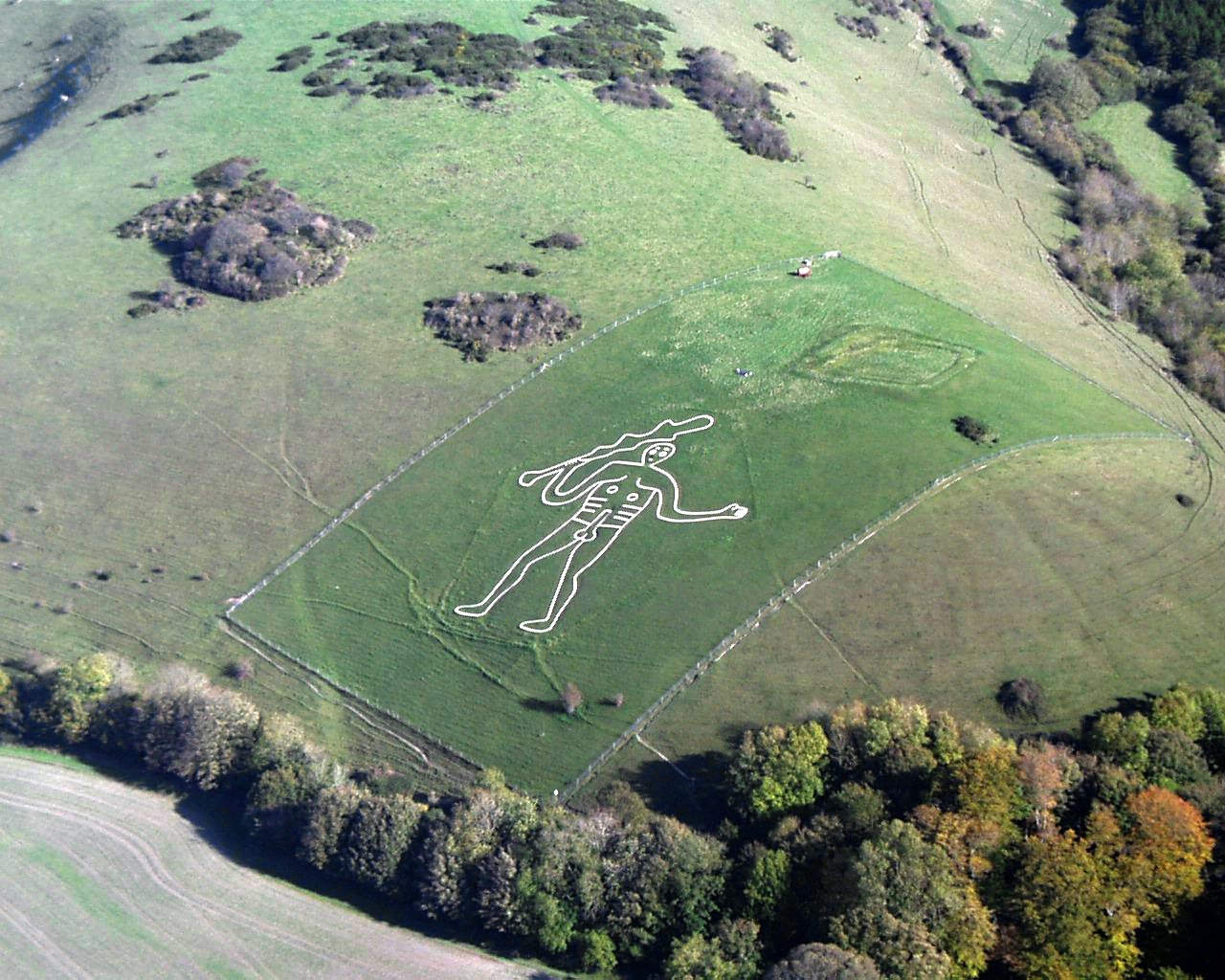
Photo: Pete Harlow · CC BY-SA 3.0

The Cerne Abbas Giant is a 55-metre-tall outline of a naked man cut into the chalk of Giant Hill above the Dorset village of Cerne Abbas. He brandishes a huge knobbed club in his right hand and sports the most famous erection in British archaeology, which has made him a magnet for fertility folklore, seaside-postcard humour and academic argument in roughly equal measure. Above him on the hillside lies a small rectangular earthwork called the Trendle, where a maypole was traditionally raised. For more than a century the giant was the subject of a genuine three-way dating stalemate. One camp saw a prehistoric fertility god; another saw the Roman hero Hercules, who is conventionally shown with club and lion-skin; a third noted that no document mentions the figure before 1694 and argued he was a 17th-century lampoon of Oliver Cromwell, perhaps commissioned by the landowner Denzil Holles. Uniquely among Britain's chalk figures, all three camps turned out to be wrong.

See it on the globe →
The mainstream view

What archaeology says

In 2020 the National Trust, which has owned the giant since 1920, commissioned the first scientific dating of the figure. Senior archaeologist Martin Papworth excavated small trenches at the giant's elbows and feet, and Phillip Toms of the University of Gloucestershire applied optically stimulated luminescence dating to the deepest chalk layers. The results, announced in May 2021, were a genuine shock: the earliest material dated to AD 700–1100, meaning the giant is late Saxon or early medieval — too late to be prehistoric or Roman, and far too early to be a Stuart-era satire. Supporting evidence came from microscopic snail shells in the sediments belonging to species only introduced to Britain in the medieval period. Papworth suggested the figure may then have been neglected and grassed over for centuries, explaining why surveys such as John Norden's in 1617 fail to mention it before its sudden documentary appearance in 1694.

The dating transformed the interpretive landscape. In a 2024 study in the journal Speculum, Oxford medievalists Helen Gittos and Thomas Morcom argued the giant was originally an image of Hercules — the club is his standard attribute, and a National Trust geophysical survey suggests his free arm once carried a cloak, plausibly the Nemean lion's skin — cut as a landmark and muster station for West Saxon armies during the Viking wars. The site commands major routeways, fresh springs and a royal estate, exactly the assets a muster point required, and Hercules enjoyed a documented revival in Anglo-Saxon learned culture.

Gittos and Morcom further proposed that the monks of Cerne Abbey, founded at the foot of the hill in 987, later reinterpreted the embarrassing pagan strongman as their local hermit saint Eadwold, who was said to have planted his staff on the hill. The giant thus becomes a rare case study in how one image can be serially re-read — Hercules to saint to satire to fertility idol — while the chalk itself stayed put.

Key evidence cited
  • 2021 OSL dates from the deepest chalk layers bracketing creation to AD 700–1100 (Toms and Papworth)
  • Medieval-introduced snail species found in the figure's earliest sediment layers
  • Gittos and Morcom's 2024 case for a Hercules image at a West Saxon muster site (Speculum)
  • Geophysical evidence of a cloak over the left arm, matching Hercules' lion-skin iconography
  • An 11th-century life of St Eadwold apparently alluding to the figure on the hill above Cerne
The alternative view

What the skeptics propose

Before 2021 the strongest alternative tradition held that the giant was an Iron Age or earlier fertility deity, sometimes named as 'Helith' after a god mentioned in medieval accounts of the district, and the figure retains a vigorous life in modern paganism as an image of raw generative power. The fertility folklore is real and long-standing: childless couples famously slept — and reportedly still do — on the phallus, girls circled the figure to secure husbands, and the maypole in the Trendle above ties the hillside to seasonal fertility ritual. Proponents argue such customs are unlikely to have attached themselves to a mere medieval landmark, and that the OSL dates could reflect an early re-cutting of a still older, lost figure — a possibility the method cannot formally exclude, since dating the deepest surviving chalk only dates the surviving fabric.

The rival sceptical tradition ran the other way: historians such as Ronald Hutton long favoured a 17th-century origin, noting the total documentary silence before 1694 in a village whose abbey records are otherwise rich, and reading the giant as a crude political cartoon — 'England's oldest piece of graffiti' — mocking Cromwell as a false Hercules. The 2021 dates undercut the strong version of this claim, but its central puzzle survives intact: if the giant existed from Saxon times, why does no monk, surveyor or traveller mention a 55-metre naked colossus for six hundred years?

There is also honest debate about the giant's most celebrated feature. Survey evidence suggests the phallus was enlarged, possibly in the Victorian era or during re-cuttings that merged it with a navel ring, meaning the figure's fertility emphasis may itself be partly a later edit. Alternative writers counter that prudish eras were more likely to shrink than enlarge him, and that the earliest 18th-century drawings already show the figure much as he is today.

Key evidence cited
  • Centuries of fertility customs, from couples sleeping on the figure to the Trendle maypole
  • Medieval references to a god 'Helith' at Cerne, read as the memory of a pagan cult image
  • Complete documentary silence before 1694, still cited by supporters of a 17th-century origin
  • The argument that OSL dates a re-cutting, leaving an older original formally possible
  • Survey evidence the phallus was altered later, showing how fluid the figure's form has been

Genuinely open questions

  1. Why is the giant absent from every known document between the Saxon period and 1694?
  2. Was the figure cut as Hercules, and if so, who ordered a pagan hero onto a Christian-era hillside?
  3. How much of today's outline — especially the phallus — matches the original design?

Worth knowing

When the 2021 results came in, National Trust archaeologist Martin Papworth admitted the early-medieval date was the one answer nobody had backed — prehistorians, Roman specialists and Cromwell-satire theorists alike had all bet on the wrong centuries.